You Will Own Nothing And You Will Be Happy … or Else

It feels like Western civilization is going downhill fast. I have to thank my parents for having me in the ’80s — perfect timing, Mom and Dad.

The West was once the place to be, especially America. Sadly, that era is ending — maybe it’s already long gone. These days, the only reason to move to the West is the welfare state: free healthcare in Europe, free phones in the U.S., and free euthanasia in Canada. What a time to be alive!

If you think we’ve already reached peak insanity, think again. Klaus Schwab, the chief clown of the World Economic Forum, has announced even more “fun” for you and me — the peasants, as Uncle Klausi might call us. Sometimes they even refer to us as “worthless eaters.”

When they call us things like that in public, can you imagine what they say behind closed doors?

You’ll own nothing, and you’ll be happy” — that gem of a slogan came straight out of one of those WEF think tank meetings. The self-proclaimed elite sat around deciding what kind of world they want to impose on us next. Apparently, it’s one where private property is the next bit of freedom on the chopping block.

The interesting part about that slogan? It doesn’t say “We’ll own nothing and we’ll be happy.” No — it’s only about you and me.

The plan is simple: an unelected network of bureaucrats, bankers, and corporate overlords comes together to reshape the world in their image. What the “useless eaters” think about that vision doesn’t matter. They simply buy every institution and politician with any influence, then enforce their will.

Private property will disappear — for everyone except them. They’ll still fly their private jets to Davos for a photo op with Klaus Schwab or whoever replaces him. Meanwhile, we’ll be trapped inside our 15-minute cities, fulfilling government work quotas under the watchful eye of some AI overlord.

New York will likely show the way. Mamdani was installed for a reason — he may be the first to implement this technocratic, neo-communist system in a major Western city under the thunderous applause of a growing Muslim community that thinks that they are winning — what exactly is it that you’re winning? Certainly not your freedom.

For now, we can watch from the outside, but soon it’ll become the blueprint for every city. Our job is to observe — and to understand how it’s being done, and by whom.

The West was the pinnacle of human achievement not that long ago. We invented the car, the airplane, the computer, the internet. We discovered penicillin, created the printing press, explored space — and, let’s not forget, perfected silicone tits.

In the ’80s, everyone in the West was excited about the future. Now, everyone just misses the past.

But maybe losing it all to a global cabal of financial elites will reignite the rebellious, adventurous spirit of Western people. Maybe — just maybe — the totalitarian system the WEF dreams of will backfire and finally push us off our couches to fight for a better future.

A future where we once again own our cities, our lives, and ourselves.

How to Write a Good Remake (A Lesson From Frankenstein)

I watched the newest Frankenstein remake on Netflix yesterday. Guillermo del Toro was behind it — one of the few filmmakers in Hollywood I still get genuinely excited about.

Still, I had my doubts. It’s a Netflix production, and quality on that platform is hard to find. But this time, they really delivered. Frankenstein is a fantastic film that honors the source material while adding meaningful details of its own.

One of the main things I thought about afterward was how del Toro managed to do something Hollywood almost always fails at: creating a good remake.

We live in an era where Jurassic Park gets remade every two years, and most superhero films feel like a variation of the previous twenty. Almost all Hollywood remakes of today are terrible.

But Frankenstein isn’t.

So how did del Toro succeed where so many others fail?

I think it comes down to genuine love for the source material. Whenever I’ve seen del Toro talk about his films in interviews, he always radiates a deep affection for the stories he tells — and Frankenstein is no exception.

By contrast, when today’s filmmakers discuss Terminator, Star Wars, or Ghostbusters, they rarely sound like fans. Instead, they talk about how they can “adapt it for modern audiences” – which is just code for pervert it until it’s not like the original anymore at all.

It often seems that many modern moviemakers never even liked the originals they were handed. They’re just thrilled to have the chance to reshape them in their own image. Sure, del Toro had a vision for Frankenstein too — but his vision came from a place of admiration. In contrast, people like Kathleen Kennedy often seem to approach their projects from a sense of superiority, as if they could “do it better.”

But you can’t — not when the original was already great.

You can make a good Star Wars movie, sure. But you’ll never outdo George Lucas’s Star Wars. You can make a solid Matrix sequel, but you’ll never surpass the first one.

When you take over an already successful story, your first job is to honor what came before. That’s exactly what del Toro did with Frankenstein. He new Frankenstein was already great before him. So he didn’t try to outdo it; he simply tried to honor what was there before him and added his own style only for as long as it didn’t take anything from the original away.

The result is great movie.

A Clockwork Orange by Anthony Burgess (Books to Read #4)

I watched the movie about 20 years ago. It’s not Kubrick’s best, but it’s still an excellent film – I highly recommend watching it. The book is also a worthwhile read.

Burgess’s take on dystopian fiction focuses primarily on language, violence, and morality. The story follows Alex, a young gang leader who ends up in prison for various crimes. A new experimental method is tested on him, designed to make humans incapable of violence. However, the conditioning has unexpected consequences: once Alex is released, he becomes the victim of the very violence he once inflicted.

The totalitarian state in which the story takes place resembles a futuristic version of 1990s Great Britain. Most people are glued to their televisions, parents are detached from their children, and the youth have no vision beyond short-term pleasure.

Much like in 1984, A Clockwork Orange shows how language can be used to control not only thought but emotion. The protagonist is morally “bad,” yet he doesn’t truly understand the difference between good and evil because he lacks the language to express these concepts. His passion for classical music hints at an inner longing for beauty and, through it, a kind of moral guidance. But neither his parents, his friends, the state, nor even the only beauty he knows – classical music – can offer that guidance.

The world Burgess portrays is one devoid of any morality. Even the government’s conditioning program, which aims to produce moral citizens, fails to reach the essence of morality – that which comes from reason and empathy.

The invented slang of the characters makes the book difficult to read at first, but once you get used to it, the rhythm of the language becomes engaging. If you’re not much of a reader, the movie is your go to piece of entertainment– it stays relatively close to the novel’s story and delivers the basic talking points while also giving us Kubrick’s trademark filmmaking aesthetics.

A Clockwork Orange on Goodreads

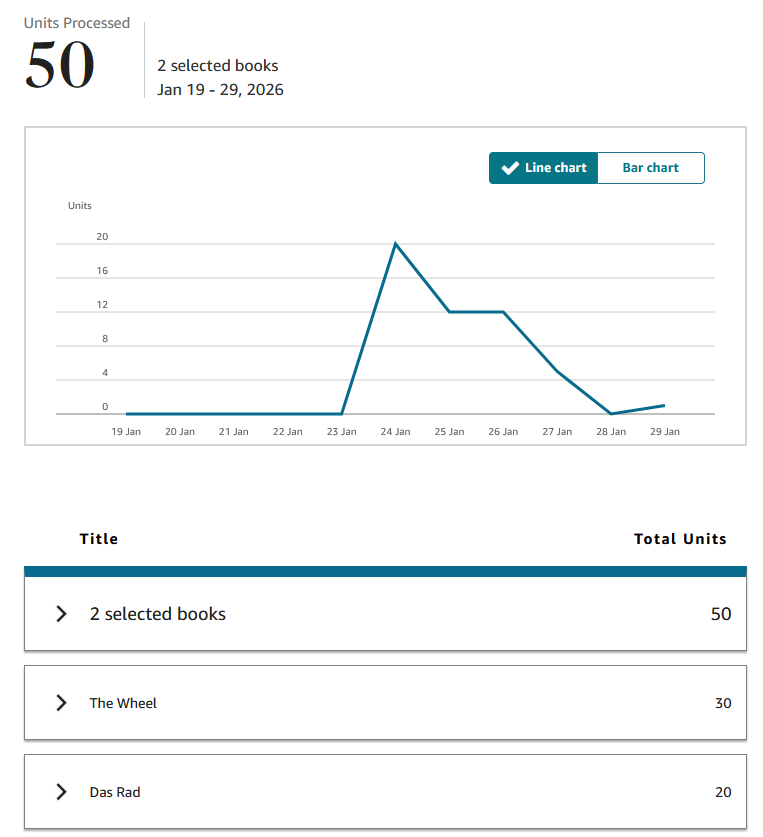
Share Your Numbers Transparently

My book sales are abysmal.

This week, I gave away another short story called The Last Portrait. I only shared the link on one specific social media profile to see if it would make any difference. It didn’t. As of today, I’ve had only two downloads — for a free book!

I started from zero, so I expected the numbers to be low in the beginning — and maybe for quite a while. Still, I decided to put my numbers out there.

And I’m doing it for two reasons:

1. It creates an authentic record of my progress.

Two downloads are terrible, sure — maybe even embarrassing to share. But ten years from now, this will be part of my story: how a beginner author with no audience tried to make something happen. Maybe I’ll fail completely. But if I do, at least this blog and my transparency will show what didn’t work.

2. It builds trust.

Most things online are fake. People claim all sorts of things on their profiles. How many “lifestyle influencers” out there are actually broke — just faking it until they make it? I’d guess a lot more than those who truly live the lives they portray. What they never show you is how they failed. No, they always succeed at everything. Sure…

With me, you get the real, authentic version — including the failures. That’s why, when I finally succeed at something, you’ll know you can trust me.

My YouTube tutorial channel now has over 11K subscribers. After my first year, I only had 59 subs. It’s still far from being life-changing, but it pays a few bills nowadays. I’m finally in a position where I can teach something about YouTube with real experience — and you can be sure I didn’t fake my way there.

The same will happen with my writing. Maybe in seven years, I’ll be able to say that my books help to pay the bills — maybe it’ll take even longer. But when that day comes, you can be sure I’m telling the truth, because I’ve been sharing my failures from day one — by sharing my numbers.

New York Finally Falls for Communism

So, Mamdani has won.

Congratulations to everyone who doesn’t pay taxes in New York—including all government workers. For those who do, things are about to get ugly.

When 9/11 happened, I was actually serving in the German military. It was a shocking event that sent ripples all the way to Berlin. Back then, we were ordered to double all security measures—days off were canceled, controls were tightened, fear was spread.

Twenty years later, New York has become a place that has actually elected a Muslim mayor. Travel back two decades and try telling that to New Yorkers. Immigration certainly played a massive role in this. Some claim that Mamdani received heavy financial backing from Islamic interest groups. There is also a high probability that all elections in the West are rigged.

But it’s also the foolishness of the liberal upper class that made this possible.

In their attempt to appear morally righteous, many Western loonies are now voting for socialist measures that will inevitably pave the way toward totalitarian communism. They fail to grasp that they’ll be the ones footing the bill, while only the politicians grow rich and powerful.

The lower class will be hit hardest—as always under communism.

At first, they’ll be gaslit into believing that everything is now “free.” But nothing is ever free when it comes from the state—it’s just taxpayer-funded. And the moment the biggest taxpayers realize this, they’ll flee to protect the fruits of their labor. History has shown time and again that people will go to great lengths to escape communism once the money runs dry, while nobody ever faucht to escape towards a communist country.

Who will pay for all the “free” stuff once your taxpayers are gone?

Exactly—no one.

And that’s when everything collapses. Public housing, transportation, medication, welfare—eventually, it will all grind to a halt. Once the communists admit that it’s no longer viable to offer these services for “free,” those who used to provide them for a fee will already be gone. The result? You won’t be able to get anything—neither for free nor for money. It’ll all be gone for good.

I feel sorry for the sane New Yorkers who didn’t vote for this. They do exist. But like in every major Western city—Berlin, London, Paris, Los Angeles—the power-hungry communists sink their teeth into the hardworking population and drain them dry like the parasites they are until nothing is left.

All they can do is to run away and watch the inevitable collapse from a safe distance.