Get My Latest Short Story The Wheel for Free (STORY52 No. 11)

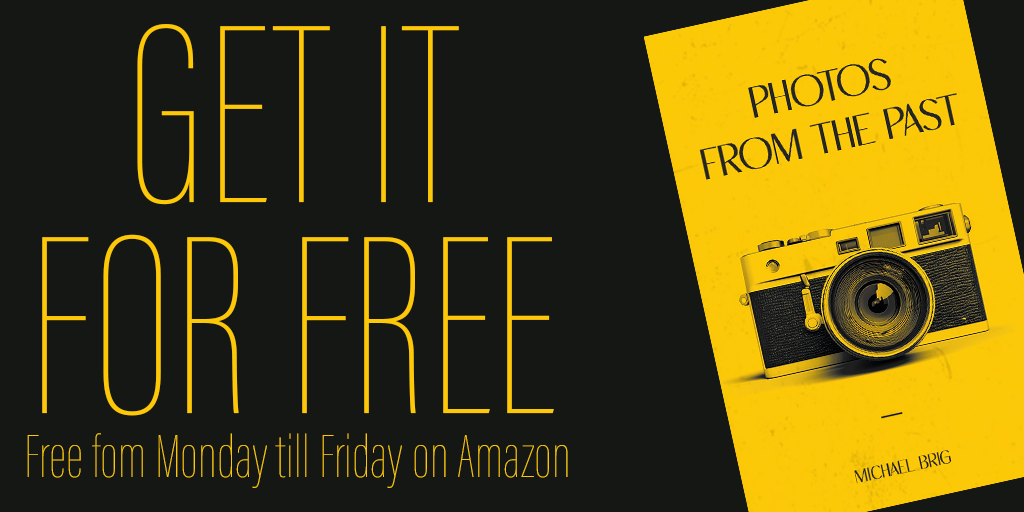
Usually, I make my short stories available for free on Mondays. However, since I already published No. 11 of the STORY52 series, The Wheel, yesterday, I decided to run a little experiment and make it free from Saturday through Wednesday to see if this helps me reach more readers.

On YouTube, fewer people watch my tutorials from Friday to Sunday. Viewership starts to rise again on Mondays and typically peaks on Wednesdays. I assumed the same pattern might apply to book sales—but maybe I’m wrong.

It could be that people are more likely to browse Amazon for new books to discover on weekends, when they’ve got more time for leisure activities. Let’s find out.

As always, the digital edition is free. You can read it on a Kindle device or via the Kindle Online Reader if you don’t own the device.

Synopsis:

A village. A wheel. A task that must never end.
When Joseph Richter becomes stranded in Treadwell, he encounters a community whose daily life revolves around a single, inexplicable duty: the relentless turning of a massive wooden wheel. No one asks questions. No one stops working. Never.

A dark, oppressive short story by Michael Brig, approx. 11,000 words.

US version | https://www.amazon.com/dp/B0GJDSY9RR
German version | https://www.amazon.de/dp/B0GJF9XW2H

If you enjoyed the story, I’d really appreciate it if you left a review on the good old Amazon website. And if you never want to miss a giveaway, you can sign up for my mailing list here.

Take care,
BRIG

I Should Have Finished My STORY52 Project First

I bit off more than I could chew.

Trying to write 12 books in 12 months is still something I believe is possible for me—but not while I’m also trying to finish my short story project. Today, I uploaded story no. 11 (The Wheel). You can get it for free today if you have Kindle Unlimited. If not, just wait until next week, when I’ll make it freely available from Monday through Friday.

It’s around 11,000 words—roughly a fifth of a full novel.

When I look at the other 41 short stories I still plan to release as part of this project, I have to admit it will take more time than I originally hoped.

Whenever I try to write, edit, or translate another novel, that time has to come out of the STORY52 project. And when I focus on the short stories, there’s no time left for the novels. It’s a dead end with no easy solution, especially since my YouTube project takes time too—just like my real-life work.

I estimate that writing The Wheel took about 12 hours, followed by another 12 hours of editing and around 4 hours of translation. Today alone, I spent 3 hours designing the cover, finalizing the formatting, and uploading it to KDP, including the metadata. That’s roughly 30 hours of work in total.

For a full novel, I estimate around 60 hours for writing, 90 hours for editing, and 30 hours for translation. The additional 3 hours for cover design, formatting, and KDP setup stay roughly the same.

When I add up the work still required to publish the remaining 41 short stories, I’m looking at the equivalent of 6–9 full novels of work in this project alone.

Because of that, my main goals for 2026 have shifted:

  • Finish the STORY52 project completely
  • Publish the second part of my 17 series
  • Publish as many additional novels as possible—though certainly not 11 more

Last year, I published 10 short stories and 3 full novels. Reaching 42 short stories and 4–5 novels is now the new goal. If I can achieve that, I should be ready to attempt 12 novels in 12 months next year.

It’s not a great way to start the year—completely turning my main goal upside down—but I don’t see how I can realistically manage 12 novels in 12 months and 42 short stories on top of that. Besides, there is also private life which has thrown some serious health issues my way that I need to deal with.

It’s a mess.

I just hope I can clean up that mess and be ready to tackle the big 12-in-12 project next year.

The Best Love, Death & Robots Episode So Far

Love, Death & Robots is hit-or-miss in many ways, which isn’t surprising given the anthology format, with each episode telling a completely new story. Still, one episode truly blew me away—because the writing is exceptionally good.

That episode is “Bad Traveling” (Season 3, Episode 2).

The story follows a ship’s crew member who strikes a deal with a monster from the deep, and the way the narrative unfolds is nothing short of genius. Looking at the track record of writer Andrew Kevin Walker, you’ll find absolute bangers like 8mm, Se7en, and Sleepy Hollow. The other writer, Neal Asher, is mainly credited for his work on the show itself, at least according to IMDb.

The episode runs for just 23 minutes, yet it delivers multiple twists you won’t see coming. The protagonist is perfectly fleshed out in that short amount of time, and the ending is deeply satisfying.

I can only describe the writing as brilliant.

There is so much to learn from this twenty-minute short if you want to become a better writer. I highly recommend watching it if you haven’t already. And even if you’re not looking to study storytelling, watch it simply for pure entertainment.

To Andrew Kevin Walker and Neal Asher: congratulations, gentlemen. I’m genuinely in awe of the masterpiece you brought to life.

I Prepare For a Life Without Retirement

Once again, there is talk of raising the retirement age in Germany.

Not long ago, we were told that borders needed to be opened so there would be enough people to pay for our pensions—funny how quickly that argument was abandoned.

The current life expectancy in Germany is 80.5 years. For men, it is only 78. Now there are discussions about raising the retirement age to 73. That brings us close to a reality where the average man pays into the system for his entire working life without receiving much in return.

“Just pay for your retirement privately,” you might say—and technically, you’d be right. The problem is that in Germany, you are forced to contribute to public systems in many ways, including retirement plans. There is simply no way to opt out while living in this country. That is how socialism works.

On top of that, insurance companies are required to invest large portions of private retirement funds into government bonds to prop up a public system that wastes money and is collapsing under corruption and incompetence. When the public pension system fails, most private plans will fail with it.

Since mass migration did not solve the problems created by the state, the government is now playing its final card before admitting that public pensions will no longer be paid out at all: raising the retirement age so that as many people as possible die before ever reaching it.

So what happens once the age is raised to 73?

They won’t stop wasting taxpayer money. They won’t slow down migration. They won’t do anything to prevent ever-growing state debt from consuming all public funds. A decade later, they will simply demand another increase—this time to 75. After that, it will be 76, 77, 78, 79…

I’m preparing for a life of continuous work until the grave, while investing my money in perceived safe havens such as gold, silver, and crypto. I am also preparing by building jobs and income sources that I can still do with a broken body—which inevitably comes with age—such as computer work, writing books, and creating passive income streams.

Since insurance systems will collapse along with the state, I am preparing by relying on no one but myself and my family for the final stage of my life. And if you want my advice, I recommend you do the same because Germany’s problems are almost everywhere in the Western world.

Are Quickly Written Books Bad Books?

I’ve seen people say they don’t want to read a book that came out of NaNoWriMo.

If you’re not familiar, NaNoWriMo stands for National Novel Writing Month. Participants are challenged to write a novel of at least 50,000 words in a single month. You can technically start any time, but every November 1st, NaNoWriMo takes over social media as thousands of writers announce their goal to complete a novel in 30 days that day.

For some reason, many people assume that books written under this challenge must be badly written. I once stumbled across a Medium article (before they banned me) titled: “Thanks, but if your book was written in 30 days, I’m not interested.”

Sure, with so many people participating, there will inevitably be a lot of rough drafts—and some of those even get published. Perhaps the author of the Medium post encountered some poorly written stories and then generalized from there.

But just because a book is written quickly doesn’t mean it’s bad.

Think about the opposite: does a book automatically become good if it takes a year to write it? Or is a novel written over a decade necessarily superior to one completed in two years? The answer is obviously: no.

Consider some famous examples:

  • Stephen King wrote The Running Man in just two months.
  • Treasure Island by Robert Louis Stevenson was written in two months too.
  • Hemingway’s The Old Man and the Sea was completed in roughly 8 weeks.
  • Steinbeck’s Of Mice and Men was written in a month.
  • H.P. Lovecraft often wrote stories within weeks, sometimes days.
  • Stevenson reportedly wrote The Strange Case of Dr. Jekyll and Mr. Hyde in only three days.

It’s not limited to literature. The script for Rocky took Sylvester Stallone four days. Sam Raimi wrote The Evil Dead in three weeks. Even a complex drama like Good Will Hunting was written in just seven weeks.

Music follows the same pattern: Ozzy Osbourne claimed that Paranoid, one of Black Sabbath’s biggest hits, was written in ten minutes—music and lyrics. Paul McCartney wrote Yesterday in a dream and merely jotted it down upon waking. Smoke on the Water was improvised in front of journalists who wanted to see Deep Purple write a song live.

The bottom line: when creativity strikes, time doesn’t matter. You can write a masterpiece in days, or toil for a lifetime and produce something forgettable.

If you’ve got an idea, sit down and write. And if you can’t stop writing, chances are you’re creating something so engaging that readers will struggle to put the finished book down.

Of course, editing and professional proofreading matter. But don’t assume that a book automatically becomes better simply because you spent more time on it. What truly matters is the idea and your talent for shaping it into a piece of art. And if you have both, you might write a hit song in your sleep, a timeless classic-novel in days, or an Oscar-winning script in weeks.