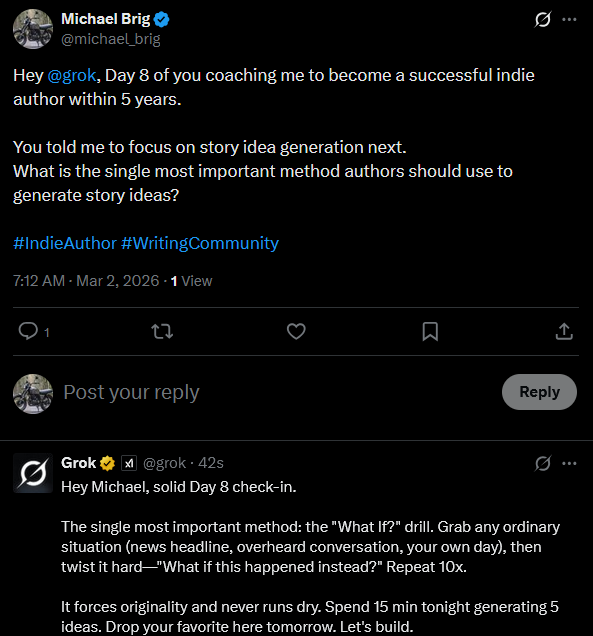
I asked Grok to further explain the method in the backend. Here is the full answer:
What if Method Explained
The “What if” method is one of the simplest, most powerful, and most widely used techniques for generating story ideas in fiction writing. It’s essentially a speculative question that takes a familiar situation, fact, person, object, rule, or event from reality (or from an existing trope/story) and twists it by asking:
“What if [something impossible, unexpected, exaggerated, or reversed] happened?”
This single question forces your brain to leap away from the ordinary and into conflict, possibility, and originality — which is exactly where good stories live.
Why it works so well
- It starts small and everyday (an observation you can make right now) but quickly escalates into high-stakes drama or wonder.
- It bypasses “I have no ideas” by using the real world as raw material.
- Almost every major story can be traced back to a “What if” core (examples below).
- It’s endlessly repeatable: one good “What if” can spawn dozens of variations.
How the method typically works (step by step)
1. Observe something normal
Look around, read news, overhear a conversation, remember a memory, or take a common trope.
Example observations:
- A child playing alone in a park
- People staring at their phones on the subway
- A solar eclipse happening on schedule
- A rat in a restaurant kitchen
2. Ask “What if…?” and twist it
Add one surprising, contradictory, extreme, or impossible element.
Push it toward conflict, emotion, or high stakes.
Examples from above:
- What if that child playing alone could see and talk to dead people? → The Sixth Sense
- What if staring at phones actually let people control others’ minds? → Black Mirror episode
- What if the eclipse was late… or never ended? → speculative short story
- What if that rat was a master chef in disguise? → Ratatouille
3. Follow the chain of consequences
Once you have a strong “What if”, ask:
- Who would this affect most?
- What would they want/lose?
- What happens next? (escalate)
- Why does this matter emotionally/thematically?
This turns the idea into a premise, then a plot skeleton.
4. Vary the intensity
- Mild: What if someone forgot their phone for a day?
- Extreme: What if forgetting your phone erased your entire identity from the world?
- Genre flip: What if forgetting your phone turned you into a ghost?
Famous examples of “What if” origins
- Jurassic Park → What if we could clone dinosaurs and put them in a theme park… and the safeguards failed?
- Toy Story → What if toys were alive when humans weren’t looking?
- The Matrix → What if the world we see is a computer simulation?
- Jaws → What if a great white shark started hunting humans off a small-town beach during tourist season?
- Inception → What if you could enter and manipulate people’s dreams?
Practical tips to use it right now
- Keep a tiny list on your phone or notebook: 5–10 daily “What if” questions (takes 2–5 minutes).
- Combine it with other sources: news headlines, overheard sentences, random objects, fairy tales, history.
- When stuck, take any boring situation (waiting for the bus, doing dishes) and ask: “What if [worst/best/weirdest thing] happened right now?”
- Generate 10 bad/weird ones on purpose — the 11th is often gold.
Leave a Reply