Collect All Story Ideas – Especially the Bad Ones

I keep a swipe file on my computer, and I have physical notebooks scattered everywhere. I even keep one next to my bed in case an idea hits me right after waking up.

My swipe file has grown to more than 300 story ideas by now. I’ll never be able to work on all of them—and to be honest, some of them aren’t even worth developing. But I still collect every single one.

There’s a good reason for that: over the years, I’ve realized that different parts of my mind seem to wake up depending on which stage of writing I’m in. To make the part I currently need work best, I have to quiet down all the others.

For example: The most creative part is needed for generating new ideas. But during editing, I need a completely different mindset, because the creative side is terrible at judging what I’ve written. Outlining requires yet another area—a blend of creativity and critical thinking.

When I don’t let one specific part take over, they all start talking over each other. And when that happens, nothing works: idea generation, outlining, editing… everything just falls apart. Too many cooks spoil the broth.

That’s why I collect ideas without judging them at all. I don’t rate them or evaluate them—I just write them down.

Only later, once I’ve finished a book and I’m deciding what to work on next, do I go through my swipe file and rate the ideas.

I’m convinced that if I tried to generate and judge ideas at the same time, I would discard most of them, assuming they weren’t good enough. Eventually, I’d end up with no ideas at all, because the constant cycle of generating an idea, rating it poorly, and throwing it away would discourage the creative part of my mind from offering ideas in the first place.

By making it a habit to let ideas emerge freely and uncritically—and by writing them down no matter how good or bad they seem—I’ve allowed the creative part of my brain to express itself without hesitation.

Of course, everyone works differently. But if you’re thinking about writing your own stories, I recommend trying this approach: Keep a notebook with you at all times and jot down whatever comes to mind while watching a movie, reading a book, daydreaming, waiting at the doctor’s office, or listening to music. I’m pretty sure that when you look back over your notes after a month, you’ll find at least one idea in your swipe file that’s worth developing.
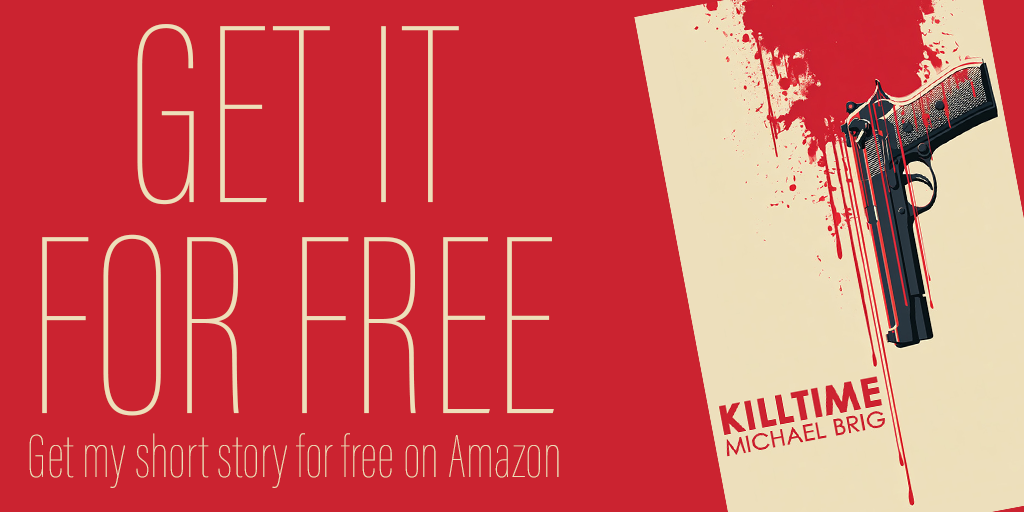
Killtime For FREE This Week (STORY52 No. 9/52)

The next short story is published. You can get “Killtime” for free until Friday on Amazon:

In the shadows of a future where attention is the only currency, a man hunts for what everyone craves—clicks, followers, fame. And there’s only one way to get it: the next kill.

Killtime is a darkly satirical short story by Michael Brig — approximately 1,100 words.

US Version | https://www.amazon.com/dp/B0G3J1S4YS
German Version | https://amazon.de/dp/B0FXS9YM9N

As always there might be some delay with the free promo depending on the country that you live in, but it should be set to free today until the promo runs out on Friday.

If you liked it, please leave me a review on Amazon, thanks.

Finish What You’ve Started Writing. Always.

This week, I had a bit of an epiphany. I’d just completed my STORY52 project and had to decide what to work on next. I started with four different ideas, and after writing two pages for each, none of them clicked. So I abandoned all of them.

However, abandoning them didn’t free my mind. It didn’t help me think about the next idea or dive into a new project clearheaded. Instead, my thoughts kept circling back to the ideas I had tossed aside. I kept asking myself: Should I return to them? Is there something in those ideas worth exploring after all?

I realized soon after that most story ideas will stick with you forever—until you finally flesh them out into full stories. The 52 short stories I wrote for STORY52 are on paper and therefore out of my head. But the four ideas I deemed “not good enough” are still lurking in the depths of my mind, creeping around a dark corner to remind me of their existence whenever I start thinking about writing something else.

The only way to get these idea-creatures out of my head is to actually work on them. Even if there are better ideas in my swipe file or floating around in my mind, the abandoned ones won’t let me go until I’ve at least finished a first draft.

That experience helped me formulate a simple rule for my writing: When you start working on an idea, finish it. Always. No excuses.

I intend to stick to that rule from now on. It will lead to more stories, more books, and a lot more sanity.

Don’t Be a 14-Year-Old Online Guru

Social media has taught millions of kids to “fake it till they make it.” What nobody told them is that most people never make it. The result is an army of 14-year-olds pretending to be experts on fitness, crypto, politics, and life without having any knowledge or experience.

Influencers have learned that being early matters far more than being right, because algorithms reward novelty and anything that saturates a new niche. If you post a video about a rising shitcoin today, you’ll get more views than if you post about it next week—when its price has inevitably crashed back to near zero. Remember NFTs? All these NFT gurus have disappeared because the money flow has long dried up and with it: they hype.

Problem is: People love the hype.

So, in the race for views, jumping on hype trains becomes the bread and butter of anyone trying to blow up online as fast as possible.

But here’s the catch: you only have one reputation to lose. Once it’s gone, you’ll never get it back—just ask Jack Murphy.

The sad part is that some people really do succeed by faking it. There are those infamous twin influencers who’ve been riding the wave of low-IQ hype content since they were teenagers. And other 14-year-olds see this as a blueprint, because that one example turned into millions of dollars and supermodel girlfriends.

What they don’t see are the countless others who try the same thing, fail, and permanently stain their names in the process.

If you want real advice from someone who spent six years on YouTube just to reach 10K subscribers: be real, be honest, and never fake it. Real growth takes time. A few people blow up overnight—some are even handpicked by the powers that be. But for most of us, it takes years of daily work and authenticity to build even a small audience. And you rarely hear about that, because most people aren’t willing to stick it out for that long.

But if you are willing, you’ll be on the safe side. No one will dig up dirt on you. No one will uncover lies or fakery, because you built everything slowly, organically, and truthfully without dirt and fakes involved.

That’s exactly how I intend to handle my writing project.

So far, I’ve sold fewer than 100 copies of my personal “best-selling” novel Forever. By most standards, it’s a failure—for now. But that’s how things really work online: you’re a failure for days, weeks, months, and sometimes years.

Until one day, finally, you’ve turned into a success.

Writing Tips From Robert Heinlein

Heinlein is one of my favorite Sci-Fi authors — if you haven’t seen it already, watch Predestination which is based on a Heinlein short-story for a nice mindfuck and a general idea of what a great writer (and thinker) Heinlein was.

During some reading about his work I stumbled across six simple rules Heinlein set up for aspiring writers:

  1. You must write
  2. Finish what you started
  3. You must refrain from rewriting, except to editorial order
  4. You must put your story on the market
  5. You must keep it on the market until it has sold
  6. Start working on something else

I love it. It is minimalist, it is based on free market principles, it is about doing the work.

Robert Heinlein was a libertarian which shines through his writing. And his approach to being a writer goes in the same direction: Do the work and let the people decide if you stuff is good enough or not. In the end: Not all good writing sells, but all writing that sells is good.

How far can I get as an indie writer?

I’ve decided to apply Heinlein’s rules to my own pursuit as a writer some time ago. 1,000 words a day is my minimum goal which will results in at least 365K words a year.

This leaves me with at least 4 full novels by the end of each year. By doing my own editing, translating, and cover design, I can keep the cost low. The marketing is a different beast, sure. I’m writing this blog, doing YouTube, and writing short stories on top to get something going.

Will I succeed?

Only time will tell—and the free market.