Monster: Season 2 – The Menendez Brothers (Movie/Show Review #5)

The second season of Monster feels a bit lighter than the story about Dahmer. In some ways, it’s almost comical. You’re not supposed to laugh at what’s portrayed—but I did. The way the Menendez brothers hoaxed their way through a made-up story turns what should be a drama into something closer to a dark dramedy.

The soundtrack plays a big part in that. Using Milli Vanilli as the main musical motif is a clever choice—after all, those two became the poster boys for how the entertainment industry fakes fame into existence. It’s just like the Menendez brothers tried to fake their way out of prison.

The production value matches the first season. The set design, acting, and direction are all solid and well-executed.

There are still some racial undertones sprinkled in, but compared to Dahmer, they’ve thankfully toned it down. In exchange, we get a bit more of the familiar “hate the rich” narrative—criticizing how wealthy people supposedly get preferential treatment from the system over the working class. Fortunately, the message is not hammered into your head like it was in Season 1.

Overall, Monster: The Menendez Brothers was received well by audiences, though slightly less than Dahmer. Personally, though, I enjoyed the Menendez story a bit more.

Week 45/52 YouTube Videos

Another week has flown by, here are the two main videos I’ve produced for Monday.

StoryLines

I’ve been thinking a lot about what I would’ve done with George Lucas’ Star Wars if I was given the reigns when Disney bought it. Here is the answer:

BRIG

I’m still in the process of figuring things out with this channel. For now, it’s a place to ramble:

Hollywood isn’t cool anymore — and the movie Amsterdam proves it.

I didn’t even know this movie existed, but apparently, another A-list celebrity ensemble film was released in 2022 — and it bombed terribly.

The movie, Amsterdam, not only features some of the most famous actors in Tinseltown today, but it also had an established writer and director at the helm: David O. Russell, the man behind hits like Silver Linings Playbook and American Hustle.

The cast is massive: Christian Bale, Margot Robbie, Anya Taylor-Joy, Chris Rock, Robert De Niro, Taylor Swift, Mike Myers, Michael Shannon, Timothy Olyphant, Zoe Saldana, Rami Malek… This is an Ocean’s Eleven-style project with a staggering $80 million budget and Disney behind it.

So what happened at the box office? In the U.S., it has grossed only around $14 million and $31 million worldwide. If you factor in marketing cost, this movie must have lost more than 100 million.

For comparison, Ocean’s Eleven had a similar budget in 2001 and made $180 million in the U.S. and $450 million worldwide.

Amsterdam is just another example of the era of the Hollywood moviemaking coming to an end. Sure, we still have Christopher Nolan, Tom Cruise, and Leonardo DiCaprio, but beyond these three, no one seems able to draw audiences by name alone anymore.

They are trying to give us new stars, basically pushing them down our throats. But the audience isn’t swallowing it.

Social media has given us independent content creators and a glimpse behind the Hollywood mask — and the reality is grim. Most of these movie stars are not just misguided ideologues; many come across as outright arrogant and condescending toward fans. Opening a Twitter account may have been the worst career move most of the Hollywood people ever made.

I remember a new mid-budget hit coming out every month in addition to the big budget blockbuster every quarter. In my youth, I went to the video rental store every week to get the newest releases – and I always found something I couldn’t wait to see.

Today, the only movies that reliably make money are superhero films, animated features, or franchise installments (Fast & Furious, Jurassic Park, Top Gun). Nobody rushes to see mid-budget films trying something new. I am not waiting for the next Margot Robbie, Zendaya, or Chalamet movie, and even Steven Spielberg’s projects no longer guarantee big money (or big entertainment).

The magic is gone. Movie stars aren’t cool anymore. James Dean was, Marlon Brando was, even De Niro was at some point. In the ’80s, Tom Cruise could make everyone want to wear a Top Gun jacket. The Matrix influenced an entire fashion movement in the late ’90s. Today, the youth simply aren’t looking to Hollywood to see what is “cool”.

Author in Progress Report – October 2025

Things have been improving — both personally and for my online projects. Writing is on track, my next big YouTube course is almost finished, and the numbers are going up. We’re getting somewhere.


Website

This was my first full month of daily blogging. After 31 articles, my views increased by 53%, and my user count went up by 94%.

The site is still small — I’ve only received a handful of comments, and it’s not like I’m selling many books through it — but the increase in traffic shows that writing more really helps.

I’ll keep writing daily for as long as I can, and as long as people stay interested. Maybe this daily approach is what will finally help me build a decent audience for my writing.

Numbers in October:

  • Pageviews: 338 (+53%)
  • Total Users: 213 (+94%)

Newsletter

The setup is done, but no one has really signed up yet. I need to find a way to get this moving.

Offering a free book to anyone who joins the list, plus weekly notifications about free Amazon book promos, should be enough incentive to subscribe.

Anything more would feel spammy — and I don’t want to be that guy. The internet already has enough spammers.

If you’d like a free book and want to stay updated on weekly free Amazon downloads, sign up here: Endless by Michael Brig


Free Books

I managed to get somewhat back on track with this project in October, although a strict weekly schedule turned out to be unrealistic due to other commitments.

STORY52

I’m still determined to publish all 52 short stories by the end of 2026. These stories will also serve as free weekly promos for years to come.

So far, I’ve written 38 stories — 8 of them are already published and available on Amazon. The plan is to write the remaining 14 stories in 2025. Editing, translating, and publishing all of them will then become a weekly task for 2026.

This month, I published Protocol Twilight (US – DE).

If you haven’t grabbed it for free yet, add it to your Amazon wishlist and wait for the next promo in a couple of months.

Protocol Twilight – Free Promo Downloads: Promo period from Monday, Oct 27 to Friday, Oct 31

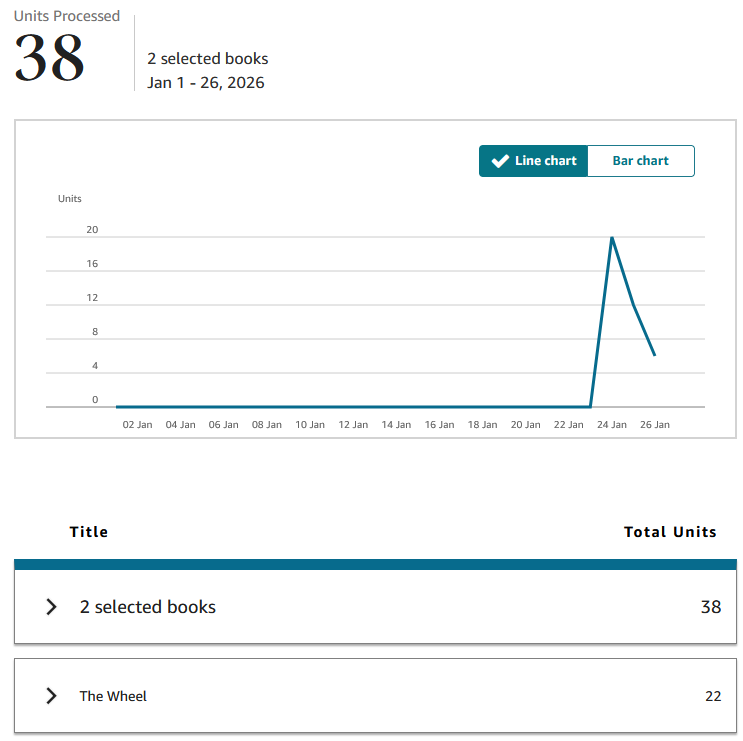
  • German version: 13 downloads
  • English version: 4 downloads

Writing

I focused mainly on short stories this month — I think I wrote around 20 of them.
That focus, however, came at the expense of my novel writing and editing.

My goals for 2025 remain the same:

  • Finish writing another novel (working title: Influencer)
  • Release the first part of my 17 series (working title: Like a Rolling Stone)

Project Updates 2025

  • Forever – Released in July (US / DE)
  • Endless – Free book for newsletter subscribers, released in September (get it here)
  • 17 Series – Part 1 is 80% complete; target release before Christmas 2025
  • Therapy – Written; planned release early 2026
  • Crowley – Written; planned release summer 2026
  • Influencer – Currently outlining; goal to finish writing by end of 2025

I also plan to release a few more short stories this year — not weekly, but around 3–4 more should be manageable.


X / Twitter

This month’s Twitter updates brought even more censorship — especially in Germany. That made me rethink my efforts on the platform.

I’ll still share links to my articles and videos, and I’ll continue posting movie reviews whenever I watch something new. But for now, I won’t invest time in commenting, sharing, or creating unique content there.

There’s no point writing for Twitter when shadow banning buries your posts in oblivion.

But you can follow me here: @michael_brig


Instagram

No real changes here — I’m still just posting my book covers for now.

Follow me here: Michael Brig IG


YouTube

A better month overall!

I’m almost done with a 12-hour course about the new version of GIMP, which I’ll release for free on my tutorial channel. I also managed to produce almost daily Photoshop tutorials.

In addition, I created more video essays and launched a new personal channel:

    OnPaper follows my author journey — perfect if you’d rather watch and listen than read my articles.

    StoryLines is a video essay channel focused on storytelling in film and TV. The latest video covered the two Judge Dredd movies; next up is Disney’s Star Wars.

    BRIG is my new personal channel — just for fun. I plan to share thoughts and ideas for now. Later drone shots, bike rides, AI experiments, travel clips, and creative projects are planned. It’s simply a space to keep the creative energy flowing.


    Conclusion

    October was a much better month overall. The website grew, I started another YouTube channel, and the STORY52 project is back on track.

    Compared to September, my health has also improved. I’ve got a few doctor’s appointments next week — hopefully things continue getting better from here.

    Wish me luck!

    A Brave New World by Aldous Huxley (Books to Read #3)

    I had read this dystopian novel years ago, and it was time to refresh my memory with another reading. Interestingly, Huxley’s family was deeply involved in social engineering—his brother Julian Huxley, for example, worked with multiple government organizations and think tanks exploring transhumanism and technocracy (source). His father was also big name that pops up when you look for The New World Order.

    Aldous Huxley’s writings might be seen as a fictional projection of the direction in which social engineers have been moving humanity for decades (if not longer).

    The Brave New World of Today

    In A Brave New World, technology allows humans to be bred into five distinct classes, each fulfilling different societal roles and, crucially, each content with their position.

    • Alphas, the most intelligent class, rule society and could not imagine finding happiness in any other role.
    • Epsilons, the lowest class, cannot read or write, nor do they wish to. Their tasks are so simple that even a “cretin” could perform them, as it’s said in the book. Low-skilled labor satisfies them, while the responsibilities of an Alpha terrify them.
    • The other groups fall somewhat in-between, but are all bread to enjoy their group specific tasks and hate everything that goes beyond.

    Whenever anyone feels discontent, there is always a drug called Soma that can deliver instant happiness. Those who cannot conform are exiled to islands—for their own safety and that of society. Anyone challenging the idea that this technocratic future is ideal simply does not fit in.

    All of this bears a striking resemblance to the Western world today: drug use is skyrocketing, escapism is widely pursued as the highest form of happiness, one’s upbringing heavily influences life outcomes, and dissenters are often labeled extremists who then get censored, de-platformed, or worse.

    The final version of this technocratic future is still centuries away. In Huxley’s world, humans are fully bred in laboratories; nobody gives natural birth anymore to children. We haven’t reached that stage yet. However, many of his predictions were uncannily precise: the indoctrination of infants and the normalization of promiscuity in society echo strikingly in modern times.

    What Huxley Missed

    The current technocrats’ plans are flexible. Their ultimate goal is total control over a population of humans who not only accept but embrace their own enslavement. The specific methods don’t matter; what matters is that society progresses toward the goal of total state-run control year by year, election by election.

    Since Huxley wrote his novel, the techniques of control have evolved. One area he overlooked is the intersexual power dynamic. In A Brave New World, men and women are nearly identical—coming together solely for frequent, promiscuous sex, otherwise performing the same societal tasks.

    In reality, technocrats have leveraged feminism to undermine the foundations of the Western world:

    1. Freedom
    2. Reason
    3. Individuality

    Feminism serves as a tool because men and women have inherently different reproductive strategies—in simple terms: women seek quality, men seek quantity (simplified). While breeding humans in a lab could render these strategies irrelevant, once reproduction becomes obsolete, one can ask: why would social engineers even need two sexes?

    The push toward androgyny has already begun. Men are encouraged to be more emotional, women more aggressive and assertive. Meanwhile gender is declared a social construct anyway. The ultimate goal may be the creation of a genderless human—a final stage resembling Huxley’s vision in a one-gendered species: an asexual, non-reproductive human worker drone.

    A Brave New World TV-Show

    The 9-part series from 2020 was cancelled after just one season. Reviews on IMDb are mixed (Brave New World on IMDb). I can understand why. The first few episodes are mediocre at best, but around episode three, the show becomes genuinely interesting. Unfortunately, the finale falls flat again.

    The main issue is that the series wasn’t designed as a limited run with a clear ending. Instead, it left the storyline open with a cliffhanger, presumably to set up another season—which never materialized.

    The set design is solid, directing is competent, and the acting is generally good. The production budget shows. Overall, I would rate the show 6 out of 10. It’s not a must-watch, but it’s not a complete waste of time either. If a second season ever appears, I’d consider returning.

    A Brave New World Show (Spoilers Included)

    The first half of the series largely follows the novel. The writers extended the story slightly to fill six episodes, but the additions were fair and respected the source material.

    The bigger problem is the invention of a “mastermind” behind the dystopian society—a figure absent from the novel. The character’s background and motivations are poorly developed, and the lead-up to the story’s resolution feels unconvincing.

    The show also takes a problematic turn by reinterpreting the novel’s core message. It suggests that if human nature could be “fixed,” a peaceful technocratic society might be possible. Essentially, human nature becomes the problem preventing utopia in the show. This flips Huxley’s original premise on its head: in the novel, it is society—under technocratic control—that destroys human nature, not the other way around.

    Conclusion

    A Brave New World is a compelling read that adds crucial pieces to the puzzle of why the world is structured as it is. While 1984 focuses on individual brainwashing, A Brave New World examines the collective impact of systemic control. Both are essential reads.

    The tv-show is a nice addition to watch when you get it for free. But it’s not a must watch, and you should read the book beforehand to see the moral inversion the show runners pulled with their interpretation of the source material.

    Btw, here is free audiobook version to check out: A Brave New World Audiobook