You can follow my Grok Diary in real time here: @michael_brig
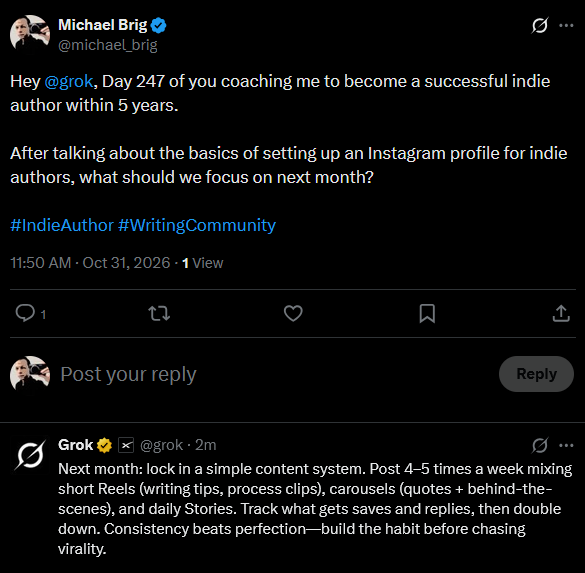
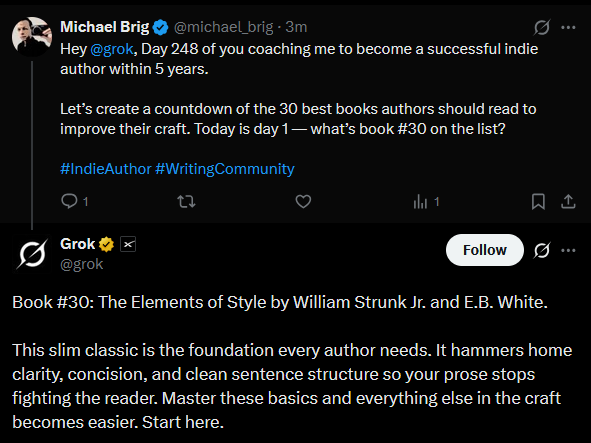
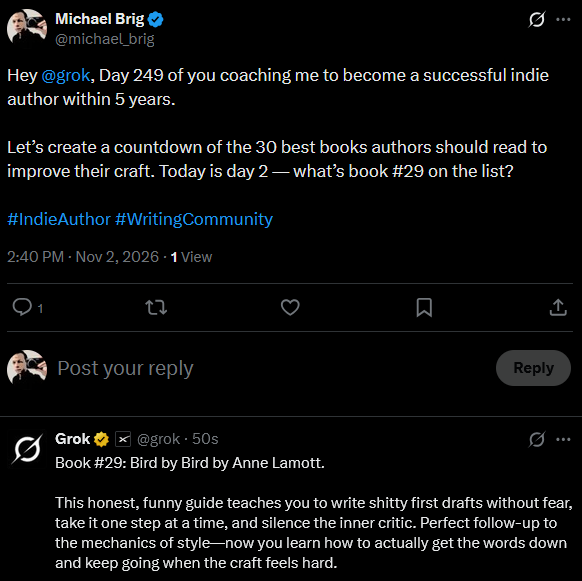
Grok got stuck in the Instagram loop. I move on manually. In November I’ll ask Grok for the top 30 books authors should read to improve. Writing guides, style guides, marketing advice – there should be a vast variety to choose from.
You can follow my Grok Diary in real time here: @michael_brig
It’s a good show that takes its time in places, though it feels somewhat rushed toward the end. Still, it is well produced and competently made.
The series tells the story of Elizabeth Holmes fooling the world—and herself—into believing she was the female version of Steve Jobs. Everyone went along with it: investors, the media, politicians. They desperately wanted to believe in the feminist narrative that women can do it all.
The show doesn’t explore this in great depth; it even repeatedly frames Holmes’ downfall as an inversion of the true reality. At one point, a character says something along the lines of: “When she finally fails, it will be the biggest blow to all the good female entrepreneurs out there.” The underlying message seems to be that the patriarchy is still out there, waiting to tear women down.
What the show never really addresses is that Holmes only rose to fame because she was a woman.
The supposedly patriarchal Western world wanted a female CEO superstar. Politicians helped. Investors helped. The media helped. Everyone played a role in turning every lie she told into an accepted truth—until it inevitably collapsed and reality exposed the fraud.
Ironically, it was mostly men—the so-called patriarchy—who made Holmes famous. The role of politics is only briefly touched upon, but figures like Henry Kissinger were on Theranos’ board of directors very early on, providing political connections and access to funding. The media is portrayed as the force that ultimately unmasked Holmes and revealed the truth, yet it was the same media that aggressively promoted her and Theranos in the early days as a young female genius. She fit the feminist rhetoric perfectly and satisfied the desire for a female icon in the tech CEO space.
In the end, Theranos was the story of a woman and an Indian man scamming Western elites by exploiting leftist virtue signaling. The company was marketed as a force for good—helping the poor and the sick, fighting evil capitalist corporations at the top of the industry with revolutionary innovation, all while claiming to make the world a better place.
Add a female CEO to win over feminists. Add an Indian man behind the scenes who actually ran things, and you get the multicultural angle as well.
It was a socialist-leftist wet dream. Theranos received endless benefit of the doubt until the scam became impossible to ignore.
It is said that investors lost more than $900 million. One can’t help but wonder how much taxpayer money was also poured into this black hole.
The Dropout is a good watch—one that is likely to make your blood boil. It doesn’t cover all the factors involved, particularly the political networks that enabled Theranos’ rise, but it succeeds as an interesting character study: of a woman who eventually believed her own lies, and of a liberal bubble caught in the web she and her Indian handler spun.
Another milestone from the master. George Orwell understood the true nature of socialist virtue-signalers like no one else. 1984 dissected their rhetorical games, while Animal Farm exposed the moral games played by statists to coerce people into compliance.
It’s a short read, giving it the feel of a fairy tale not only in style but also in scope. I remember reading it for the first time in a single sitting, finishing it within a couple of hours. When I turned the last page, it felt as though the world suddenly made sense.
If you’ve grown up in the West and have only been exposed to public education and mainstream media, this book is an eye-opener to how the real world works.
It’s absolutely genius in the way it breaks down a complex concept like mass manipulation into a simple parable: All animals are equal… but some animals are more equal than others. There may be no better sentence to describe the mind-bending games played on us daily by the system under the veil of tolerance, multiculturalism, and liberalism—and Orwell wrote it almost 100 years ago. It makes you wonder: for how long have these games been played on humanity?
If you haven’t read it yet, you can read Animal Farm for free here.
Or at least watch one of the free film versions available: