Why I’m Putting All My Books into Kindle Unlimited

Yes, Amazon pays you peanuts if you’re not a big name.

Today’s Kindle Unlimited is primarily designed to attract the well-known authors. Amazon changed its payment structure about a decade ago to achieve that. When I first published some of my writing on Amazon, I earned more than a dollar for each read—no matter how long the book was. That made short stories surprisingly profitable. I remember earning almost $1.50 for a ten-page story collection.

Then Amazon decided that more pages should mean more money.

We can debate whether that was the right move creatively. Personally, I don’t think page count determines quality. I’ve read short stories years ago that still stay with me, and 700-page fantasy slogs that I wish I could forget the moment I finished it.

On the other hand, I understand the argument that a short story written in a day shouldn’t earn as much as a full-length novel that takes months to complete. It’s hard to find a fair system that respects everyone’s effort.

From a business perspective, Amazon’s decision wasn’t really about helping writers, though—it was about attracting big names like Stephen King. Amazon wants those authors exclusively in Kindle Unlimited, because they bring in subscribers.

Today, authors are no longer paid per book read but per page read. From what I’ve seen, a single page earns around half a cent.

Amazon also added a reward system that gives bonuses to authors with the most pages read. The result? The top 3% of authors earn roughly 50% of the total payout according to the data that I’ve seen. And that’s how Amazon gets the “Stephen Kings of the world” on board.

For me—and for most independent authors—Kindle Unlimited brings in just a few dollars a month.

So why am I still putting all my books into Kindle Unlimited?

Because I want people to read my work, even if it means I’m basically writing for a couple of dollars. When you’re just starting out, nobody knows or cares about you. You have your family, a few friends, maybe some coworkers to get your books—and that’s it.

To get strangers to check out your writing, you have to make it as easy as possible for them. If you can, even give your books away for free. Readers who already have a Kindle Unlimited subscription are much more likely to give me a chance, as for them, my books are somewhat free.

When you’re a beginner author with no publishing house behind you, money isn’t your goal. Finding an audience is. And once you’ve find that audience, money comes in as a side effect anyway.

Kindle Unlimited gives me access to readers who might never have discovered my work otherwise. These readers could be the audience of my future.

What if you build it and no one comes?

To be honest, I often doubt whether my efforts to become a successful writer will actually lead to success. Every year, millions of people publish books—on Amazon alone. Millions more have a manuscript hidden in a drawer, waiting to see the light of day. It seems almost everyone believes they can write a book.

On social media, everyone wants to be famous. There are more than 100 million YouTube channels as I write these lines. Kids today dream first and foremost of being influencers and vloggers, flooding the market at an insane pace.

As if that weren’t enough, AI looms on the horizon—a fierce competitor for humans in nearly every creative field.

So what if I write 5,000 blog posts, publish 100 books, and send 100,000 tweets, yet never find an audience?

It’s possible. Maybe even likely.

The internet will change again in the future, and the next shift might render everything I do today irrelevant.

But that only matters if I measure success in terms of external rewards. Of course, I’d love to make a living as a writer, to have a million readers on my blog, and a loyal following on social media. But above all, I want to tell the stories in my head. I believe they’re unique—dare I say, even good. Having others read (and buy) them would be fantastic, but the deeper reward lies in simply getting them out of my head and onto the page. That alone makes the work worth doing.

Ten years from now, I hope I’ll be able to say I’m a successful author. But I can’t count on it. Yet I can count on being able to say my stories and ideas are out there, waiting for anyone who wants to discover them.

So I’ll keep building—no matter how many people come…

I Gave Away My Last Book On Amazon For Free (Here are my numbers)

When you don’t have an audience and no marketing budget, giving away your books for free is the only strategy I can think of to get the ball rolling. From day one, I decided that everything I do will be available for free — at least to some degree. If you want to read my work without ever spending a dime, I’ll make that possible.

Of course, I can’t just afford to buy 10,000 copies and hand them out — I’m not rich. But I can use Amazon’s tools to offer the digital versions (Kindle) for free as much as possible. That includes enrolling all my books in Amazon’s Kindle Unlimited program and taking advantage of the 5-day promotional periods Amazon allows every 90 days for each title.

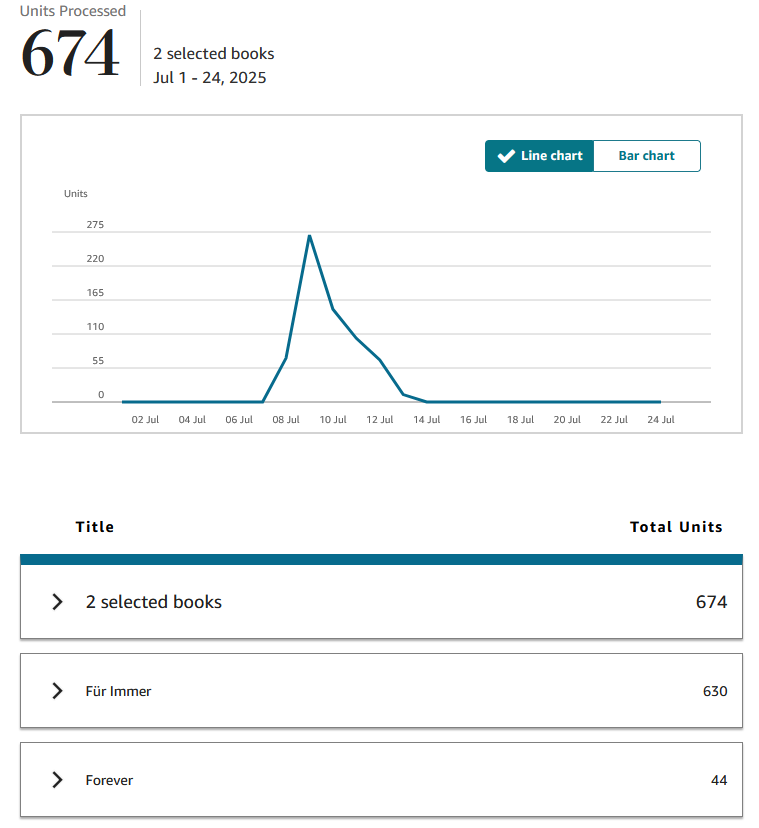
Three weeks ago, I finished my latest full-length novel Forever. I made it available for free as soon as Amazon processed it. From July 7th to July 13th, both the English and German versions were downloadable for $0.

The German version had 630 downloads — an average of 126 per day, peaking at 273 on July 10th. The English version wasn’t as successful but still reached 44 potential readers.

This is by far the biggest success I’ve had with a title on Amazon.

It didn’t make me a single dollar — so why do I call it a success?

Simple: before I launched my “author in progress” project, I had already published two titles on Amazon. But without an audience or marketing budget, almost no one bought them.

Forever (or Für Immer, the German title) didn’t just get 674 downloads that might leader to future readers — it already has 13 reviews. The high download numbers also gave it a slight ranking boost. Both factors helped attract Kindle Unlimited readers (KENP) and even paying customers after the promo ended.

Right now, I’m averaging one new reader per day on Amazon — either buying the book directly or reading it through Kindle Unlimited. I’m convinced I never would’ve reached those readers without first giving the book away for free.

Free Is the Most Honest Way to Find Readers

People know Stephen King. They know George R. R. Martin. But they don’t know me. When King or Martin release a new book, people check it out because they entertained us before. When I release a new book, no one checks it out — because I haven’t earned that trust yet.

That’s why I need to give people a reason to take a chance on me before I ask them for money. By offering my writing for free, I’m doing exactly that: inviting you to give me a chance at no risk. And if I succeed in entertaining you, you’ll know me — and maybe you’ll come back for more, even if it costs something next time.

I’ll stick to this strategy until reality proves me wrong. But so far, the numbers have clearly convinced me I’m right.

By the way, if you want to check out the book, you can get it here:
US – English | DE – German

STORY52 Book Promotion – My First Download Numbers

As announced, I’ve started releasing one short story per week on Amazon for the next 52 weeks — all available for free. In the spirit of full transparency, here are the download numbers for my first two stories:

STORY52 No. 1 of 52: Black Market Dreams | (US – DE)

STORY52 No. 2 of 52: The Last Portrait | (US – DE)

I write all my stories in German and then translate them into English which is why there are always two version of each book.

Let’s see how things develop — but for someone with no existing audience, it’s a start. And all it cost me was some time and imagination. Hopefully, a few of these free downloads will turn into loyal readers. Hopefully the promo numbers will grow as the project gains momentum.

I think I’ll include these stats in future monthly “Author in Progress” reports.

Writing 52 Short Story Books for Amazon

Publishing short stories and giving them away for free on Amazon has been the most effective strategy I’ve found so far. If you don’t already have an audience, a following, or a network, offering something for free is often your only real option.

Sure, you can rely on luck and hope your writing finds an audience on its own. But for 99% of writers, that simply doesn’t happen. It certainly won’t happen for me.

That’s why I’ve come up with a plan: I’ll write 52 short stories, publish them as Kindle books, and give them away using Amazon’s Kindle Unlimited promo tools.

I just finished my second attempt at this. My test run brought in 28 downloads for the first book and 35 for the second. Not huge numbers, but still — that’s 63 readers I didn’t have before.

The great thing is that I can reuse these books in future campaigns. The first one was only downloaded 28 times, but as my platform grows, I might be able to double that next year, triple it in two years, and maybe even attract thousands of readers over time — from that book alone.

These stories are designed to be giveaways, and once created, they can be used again and again as evergreen promotional tools that neither cost me money nor time.

Amazon allows you to run a free promotion with a book every three months. That means I can promote each book up to four times a year. With 52 books, I could be running free promos year-round — without spending a cent on marketing.

I haven’t seen anyone else trying this strategy, so I can’t guarantee that it will work. But it’s worth a shot. It doesn’t cost me anything. It doesn’t cost the readers anything. And I get to tap into Amazon — one of the biggest search engines on the planet.

Of course, it will cost me time to write the stories. But writing is fun anyway.

So far, this is the best strategy I’ve come up with. I plan to stick with it for a year and see what happens.

That means: My current plan is to write 4 full-length novels a year, plus 52 short stories on top. Wish me luck — and cross your fingers that this strategy helps me build an audience.