I’ve checked Reedsy, Seventh Sanctum und Reddit – it’s nice to have, but nowadays, AI can give you very specific writing prompts within seconds. I think that this is now the most effective way to start creating story ideas.

I’ve checked Reedsy, Seventh Sanctum und Reddit – it’s nice to have, but nowadays, AI can give you very specific writing prompts within seconds. I think that this is now the most effective way to start creating story ideas.

Checking out Notion will cost me more time. So far I’ve used OneNote. But it seems like the basic Notion plan is free. If it offers everything that I need, this could be another reason to abandon Office365.
The tips on categorizing ideas is a good one to explore. I simply wrote everything thing down and have a giant bullet point list now which is hard to navigate.
Once I’ve got a better system setup, I’ll write a more conclusive post about creating an idea bank.
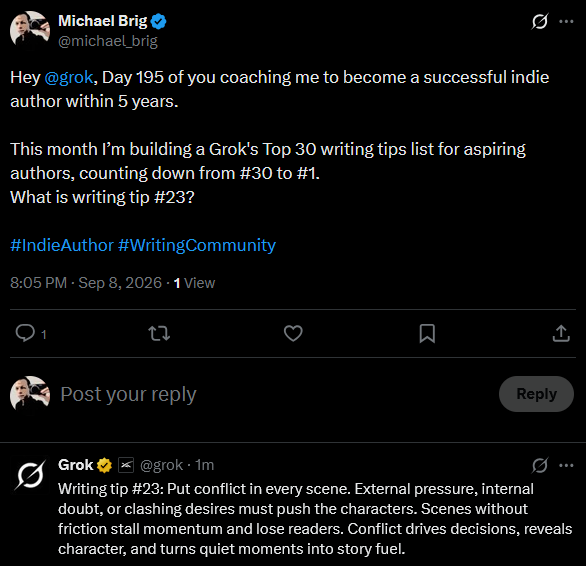
You can follow my Grok Diary in real time here: @michael_brig
For step 1 AI models have become super helpful. Just tell Grok/ChatGPT/Claude to give you some prompts, pick one and start. Even step 2 can be assisted with AI. Step 3 is then the job of the author: Pick your favorite hook and store it in your swipe file.
You can follow the project in real time here: @michael_brig

To be honest, generating ideas was never my problem. I’ve got this giant swipe file with hundreds of ideas to tap into. And whenever I do some outlining, new ideas for stories jump to mind quickly.
But I’m still looking for a 5-minute drill to use at the end of the day so that my swipe file never reaches its end. I guess, this might be a question to Grok for tomorrow.
You can follow the project in real time here: @michael_brig

I asked Grok to further explain the method in the backend. Here is the full answer:
The “What if” method is one of the simplest, most powerful, and most widely used techniques for generating story ideas in fiction writing. It’s essentially a speculative question that takes a familiar situation, fact, person, object, rule, or event from reality (or from an existing trope/story) and twists it by asking:
“What if [something impossible, unexpected, exaggerated, or reversed] happened?”
This single question forces your brain to leap away from the ordinary and into conflict, possibility, and originality — which is exactly where good stories live.
1. Observe something normal
Look around, read news, overhear a conversation, remember a memory, or take a common trope.
Example observations:
2. Ask “What if…?” and twist it
Add one surprising, contradictory, extreme, or impossible element.
Push it toward conflict, emotion, or high stakes.
Examples from above:
3. Follow the chain of consequences
Once you have a strong “What if”, ask:
4. Vary the intensity