I’m Starting to Learn Book Marketing

Writing books is one thing; marketing them is a completely different story.

By writing 1,000 words a day, I’ve already mastered the discipline part of writing. AI has helped me tremendously with book editing—making the process faster and improving the quality of my edits. The same goes for translations from German to English. My book cover design skills aren’t amazing, but they’re certainly above average. When it comes to writing style, I’m still learning something new every day—aren’t we all?

What I haven’t really tackled so far, though, is marketing. I had some ideas—creating this blog, using Twitter, making YouTube videos—and my STORY52 project is also part of my marketing efforts. But I never bought a good book on the topic, didn’t do deep online research, and never truly tried to market my books in a structured way.

As an independent author without a budget, you simply have to do it all: writing, editing, translating, designing—and marketing.

So from now on, I’m dedicating one article per week on my website to book marketing. This forces me to learn, and it also increases the value I offer readers on this blog. A win-win.

To get you started as well, check out this great resource I’ve already found: Book Marketing Bestseller

It’s by a guy named John Kremer, who also wrote 1,001 Ways to Market Your Books, a book praised by many authors.

At the moment, I’m working my way through his blog. His book is next on my list. You can find it on Goodreads here.

If I write about one marketing technique per week, I’ll have my own 1,001 ways to market books in about 20 years. Stay with me to see what number 1,001 will be.
The Wheel – Full Download Numbers

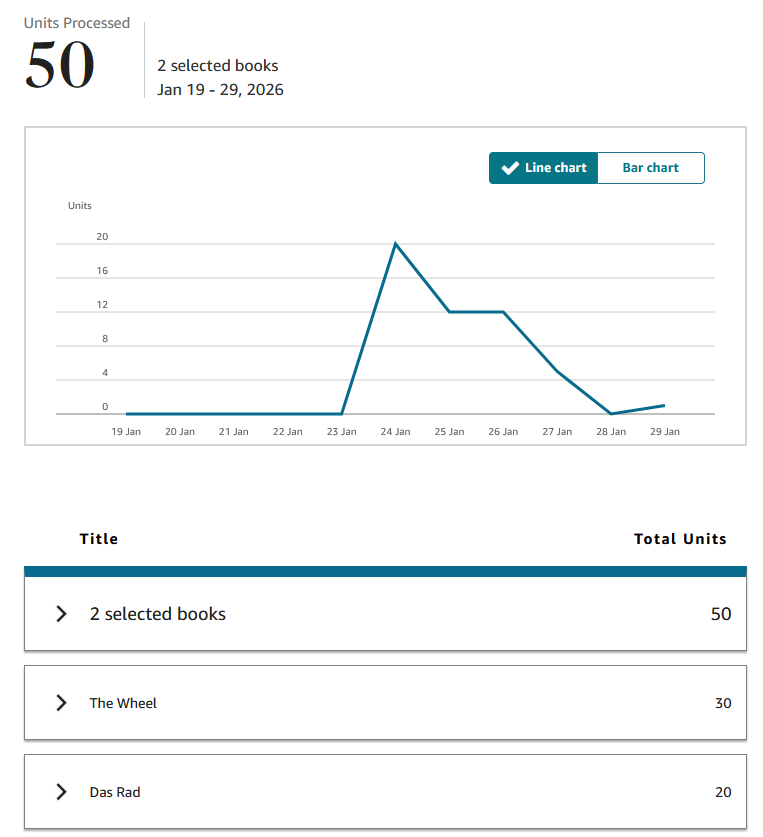
Today, the 5-day promo ended, and as I had suspected, the timing doesn’t make much of a difference: putting your book on free over the weekend or during weekdays seems irrelevant—at least from my current perspective.

The results:

  • 30 downloads for the English version
  • 20 downloads for the German version

These numbers are on the higher end of my usual range for free short story promotions on Amazon, but nothing wildly above or below my typical results.

Interestingly, this is the first time the English version outperformed the German one. It’s hard to say why that happened.

The download pattern is the same as always: the first three days account for most of the downloads, while the last two days see very few. This might be because Amazon has a specific category for new releases that people check regularly, and perhaps the book is ranked differently three days after release in that category.

Overall, my takeaway is that, for me, the timing of free short story promotions doesn’t seem to matter.

Chernobyl (Movie/Show Review #12)

You never really know whether entertainment media tells the true story of a historical event. They lie to us about many things, bend the truth to fit their narrative, and sometimes replace real historical figures, and even invert entire realities to serve political ideologies.

But when I watch shows that depict the sheer evil of communist Soviet Russia, I’m quick to believe most of it.

The current system clearly wants us to live under a state-controlled form of communism, which is why mainstream narratives often portray communism and its pre-form, socialism, in a more favorable light.

A show like Chernobyl is therefore not something I would expect to exaggerate the truth. If anything, I assume reality was even more disgusting than what we see on screen.

From a technical standpoint, the show is outstanding. The writing, cinematography, and acting are excellent throughout. It’s a top-notch production made by very skilled people. Stellan Skarsgård is in it—one of my favorites—and he delivers a fantastic performance as always. That said, the entire cast is great.

Ironically, the female protagonist who is willing to fight the communist system was entirely invented and serves as a placeholder for numerous male Soviet scientists. So yes—there’s your liberal feminist propaganda, pushed even into a show like this.

If you watch Chernobyl as a historical piece, it makes your blood boil. The communist regime “disappeared” far more people than we will ever know, and one of the greatest crimes it committed was Chernobyl. So many people suffered under state rule in the mass experiment called the Soviet Union that I genuinely can’t understand how so many people today see socialism, or even communism, as something good.

If you give the state absolute power, it will abuse it absolutely. Chernobyl was not just an “accident”; it was another example of state failure, killing innocent people on a massive scale.

Watch the show for an example of that, or what it for the entertainment value. But definitively watch it, as it’s a great show.

European Elites Have Announced Their Social Media Alternative “W” – And It’s Exactly as Bad as You’d Expect

The European elite clowns have announced plans to invest €500 million in building an alternative to X. And where will this €500 million come from? Directly from European taxpayers. Since Germany is the main contributor to the European system, I guess that makes me personally responsible for funding this disaster. You’re welcome, online ether!

The World Economic Forum technocrats are cheering. The politicians are padding themselves on the back as always. And the feminist are happy too, because they’ve appointed some woman as the figurehead of the project—so at least the female quota is ticked off.

But beyond that, there’s absolutely nothing to be found.

The platform won’t offer any technological innovation, it won’t solve a single user problem, there is no cultural relevance, and it won’t even be as useful as the platforms that already exist.

Instead, W will feature mandatory ID and photo verification for users, centralized control, speech censorship, and a direct link to Brussels’ bureaucracy and pre-approved activist groups. Has any user ever asked for more censorship, state control, and centralization on social media?

In short: W is not a platform that users need; it’s a platform that the state needs to control the users. And here’s the fundamental problem, as social media only works if users actually adopt it out of necessity.

There are countless alternatives to YouTube, Facebook, and Instagram that are superior in many ways—but none have managed to achieve mass adoption. YouTube still dominates the online video market, despite platforms like Rumble and Odysee offering more freedom and even simple crypto-features.

And if we look at X, we already have Gab, Bluesky, Mastodon, and countless others. None of them were able to get the people to abandon X. And these alternatives actually offered some advantages in regard to freedom, decentralization, and functionality.

If you want a social media platform to succeed today, you not only need to solve a real problem that users face with existing platforms—you also need the luck to get the masses to sign up.

W solves zero user problems. Its purpose is controlling the narrative—and with it the speech, behavior, and ultimately, thoughts of the people. W is just a statist’s wet dream that can’t comprehend that people are more than blind sheep following the lead of power-hungry technocrats.

Nobody will join W voluntarily, except state puppets, activist groups, and politicians.

Perhaps the clowns in Brussels will push for mandatory sign-ups at some point. In ten years, you might only receive welfare benefits if you have a W account, only be able to apply for government jobs through it, and only book public healthcare appointments via this platform. But even then, who is posting their political, cultural, and personal opinions voluntarily on W? Right, nobody!

On paper, W looks like a €500 million grave. And judging by the history of state projects, that €500 million will quickly balloon into a disaster of around €5 billion. But hey, it’s just my taxpayer that is being wasted … so, who cares?

Certainly not the clueless fools in this video about the project presentation:

Does It Make a Difference Whether You Give Away Your Books for Free on Weekends or Weekdays?

Normally, I give away my short story books for free from Monday to Friday. For my latest issue, No. 11 The Wheel, however, I made it available for free starting on Friday (the promotion will run until Wednesday). Over the weekend, I may have seen a small increase in downloads, but nothing spectacular.

So far, my best-performing short story was downloaded 45 times in German and 8 times in English over five days (KilltimeUS – DE). My worst performer was Protocol: Twilight (US – DE), with 13 downloads in German and 4 in English.

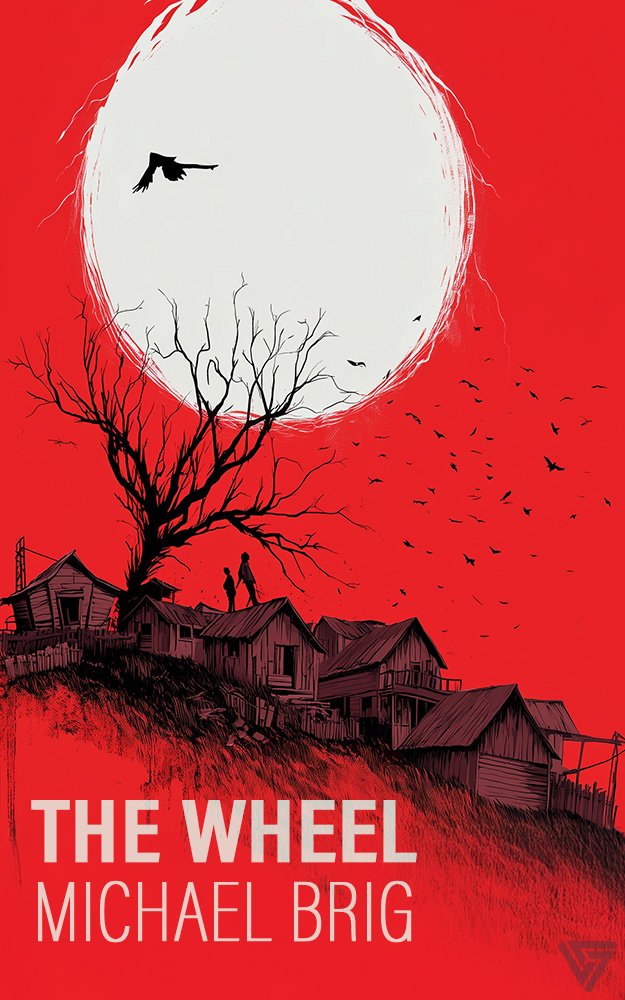
Book cover of the wheel

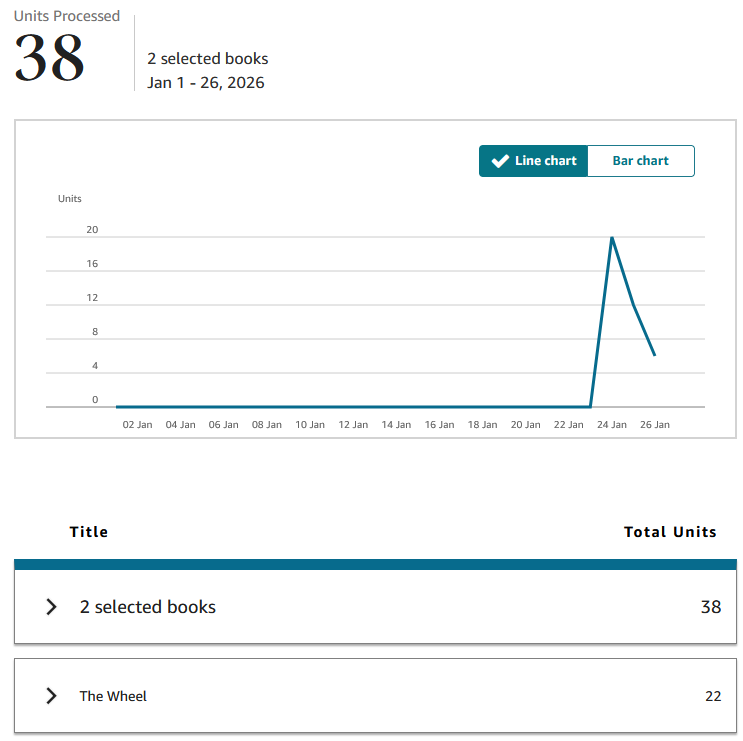
The Wheel had 22 downloads in the US and 16 in Germany over the weekend alone—you can still grab a free copy here: US – DE

That’s a slight increase compared to my average. Compared to my best issue so far, it’s roughly on the same level.

I wasn’t sure whether people look for books to read more often on weekends, even though online traffic is higher during weekdays for most of my other web projects. After this experiment, I’m still not convinced that they do. Sometimes, it’s simply the cover and the title that spark more interest in a book. Killtime, for example, just sounds more exciting than Protocol: Twilight, right?

Maybe the cover of The Wheel is one of the better ones I’ve created, which could have led to its above-average performance. Even if that’s the case, the download numbers aren’t dramatically higher than usual.

The Wheel download numbers for the free promo

For now, I’d conclude that it doesn’t make much of a difference whether I set my books to free on Fridays or Mondays.

I’ll run more experiments in the future, but for the moment, I’ll go back to running my free promotions starting on Mondays and leaving out the weekends.