Do Teenagers Still Think About College?

I watched a few episodes of Smallville over the last couple of days. I remember watching it as a young adult when it first aired on TV about 25 years ago.

The stories and characters are very simple: there’s the good guy, Clark Kent; the monster of the week; and the always-ambivalent Lex Luthor, who wants to be good but is constantly pulled back to the dark side by the world, his family, and his inner demons.

It’s easy to turn you brain off and just relax with a show like this for 40 minutes.

Nowadays, TV shows are very different.

But it’s not just the change in character construction or story development that stood out to me. What struck me the most was how every young person in the show talks about college: They want to go to UCLA, Harvard, MIT, and so on.

It made me wonder: Do today’s 18-year-olds still think this much about going to college?

Social media has exposed countless bubbles in the Western world. Politics, finances, migration… during the pandemic, even healthcare was revealed as one. Colleges are surely another bubble ready to burst.

If I were 18 again, I wouldn’t go to college at all. I’d attend trade school and build an online business in my spare time. As soon as trade school was over, I’d set myself up to start my own electrician, carpenter, or mechanic business in the real world—while my online business generated additional side income.

Right now, that seems like a much better plan than aiming for UCLA to study computer science, going to law school in Princeton, or trying to become a doctor in Harvard.

AI is coming for many jobs that are primarily computer-based. Western governments are running out of money. And constant socio-political upheaval makes many career paths a risky bet. So why go into six-figure debt for a degree that may not make you more employable in the future?

That’s a question that comes to mind when I try to see things from the perspective of today’s youth. And it’s also a question I never asked myself 25 years ago, when I chose college over trade school. Because back then, college was the end all be all. My parents told me it’s all, high schools told me so, culture did it too, and even TV-shows like Smallville told me that college should be the main thing to think about for an 18-year-old.

Times have changed. TV shows have changed. Massively.

Thanks to social media, young people can see these changes much earlier than my generation ever could. I hope they use that advantage to their benefit and make the right decision.
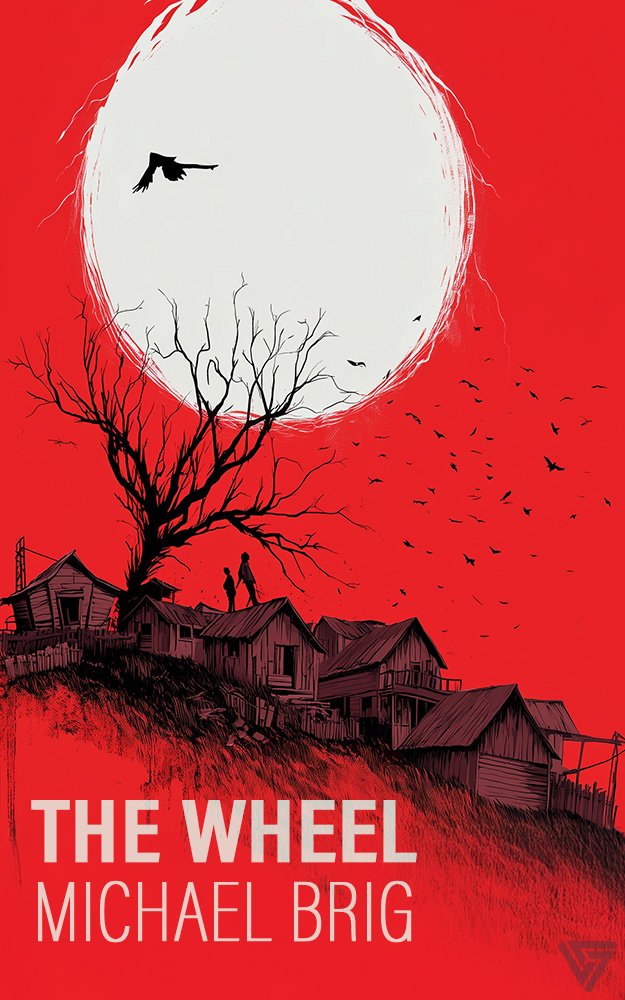
Get My Latest Short Story The Wheel for Free (STORY52 No. 11)

Usually, I make my short stories available for free on Mondays. However, since I already published No. 11 of the STORY52 series, The Wheel, yesterday, I decided to run a little experiment and make it free from Saturday through Wednesday to see if this helps me reach more readers.

On YouTube, fewer people watch my tutorials from Friday to Sunday. Viewership starts to rise again on Mondays and typically peaks on Wednesdays. I assumed the same pattern might apply to book sales—but maybe I’m wrong.

It could be that people are more likely to browse Amazon for new books to discover on weekends, when they’ve got more time for leisure activities. Let’s find out.

As always, the digital edition is free. You can read it on a Kindle device or via the Kindle Online Reader if you don’t own the device.

Synopsis:

A village. A wheel. A task that must never end.
When Joseph Richter becomes stranded in Treadwell, he encounters a community whose daily life revolves around a single, inexplicable duty: the relentless turning of a massive wooden wheel. No one asks questions. No one stops working. Never.

A dark, oppressive short story by Michael Brig, approx. 11,000 words.

US version | https://www.amazon.com/dp/B0GJDSY9RR
German version | https://www.amazon.de/dp/B0GJF9XW2H

If you enjoyed the story, I’d really appreciate it if you left a review on the good old Amazon website. And if you never want to miss a giveaway, you can sign up for my mailing list here.

Take care,
BRIG

I Should Have Finished My STORY52 Project First

I bit off more than I could chew.

Trying to write 12 books in 12 months is still something I believe is possible for me—but not while I’m also trying to finish my short story project. Today, I uploaded story no. 11 (The Wheel). You can get it for free today if you have Kindle Unlimited. If not, just wait until next week, when I’ll make it freely available from Monday through Friday.

It’s around 11,000 words—roughly a fifth of a full novel.

When I look at the other 41 short stories I still plan to release as part of this project, I have to admit it will take more time than I originally hoped.

Whenever I try to write, edit, or translate another novel, that time has to come out of the STORY52 project. And when I focus on the short stories, there’s no time left for the novels. It’s a dead end with no easy solution, especially since my YouTube project takes time too—just like my real-life work.

I estimate that writing The Wheel took about 12 hours, followed by another 12 hours of editing and around 4 hours of translation. Today alone, I spent 3 hours designing the cover, finalizing the formatting, and uploading it to KDP, including the metadata. That’s roughly 30 hours of work in total.

For a full novel, I estimate around 60 hours for writing, 90 hours for editing, and 30 hours for translation. The additional 3 hours for cover design, formatting, and KDP setup stay roughly the same.

When I add up the work still required to publish the remaining 41 short stories, I’m looking at the equivalent of 6–9 full novels of work in this project alone.

Because of that, my main goals for 2026 have shifted:

  • Finish the STORY52 project completely
  • Publish the second part of my 17 series
  • Publish as many additional novels as possible—though certainly not 11 more

Last year, I published 10 short stories and 3 full novels. Reaching 42 short stories and 4–5 novels is now the new goal. If I can achieve that, I should be ready to attempt 12 novels in 12 months next year.

It’s not a great way to start the year—completely turning my main goal upside down—but I don’t see how I can realistically manage 12 novels in 12 months and 42 short stories on top of that. Besides, there is also private life which has thrown some serious health issues my way that I need to deal with.

It’s a mess.

I just hope I can clean up that mess and be ready to tackle the big 12-in-12 project next year.

The Best Love, Death & Robots Episode So Far

Love, Death & Robots is hit-or-miss in many ways, which isn’t surprising given the anthology format, with each episode telling a completely new story. Still, one episode truly blew me away—because the writing is exceptionally good.

That episode is “Bad Traveling” (Season 3, Episode 2).

The story follows a ship’s crew member who strikes a deal with a monster from the deep, and the way the narrative unfolds is nothing short of genius. Looking at the track record of writer Andrew Kevin Walker, you’ll find absolute bangers like 8mm, Se7en, and Sleepy Hollow. The other writer, Neal Asher, is mainly credited for his work on the show itself, at least according to IMDb.

The episode runs for just 23 minutes, yet it delivers multiple twists you won’t see coming. The protagonist is perfectly fleshed out in that short amount of time, and the ending is deeply satisfying.

I can only describe the writing as brilliant.

There is so much to learn from this twenty-minute short if you want to become a better writer. I highly recommend watching it if you haven’t already. And even if you’re not looking to study storytelling, watch it simply for pure entertainment.

To Andrew Kevin Walker and Neal Asher: congratulations, gentlemen. I’m genuinely in awe of the masterpiece you brought to life.

I Prepare For a Life Without Retirement

Once again, there is talk of raising the retirement age in Germany.

Not long ago, we were told that borders needed to be opened so there would be enough people to pay for our pensions—funny how quickly that argument was abandoned.

The current life expectancy in Germany is 80.5 years. For men, it is only 78. Now there are discussions about raising the retirement age to 73. That brings us close to a reality where the average man pays into the system for his entire working life without receiving much in return.

“Just pay for your retirement privately,” you might say—and technically, you’d be right. The problem is that in Germany, you are forced to contribute to public systems in many ways, including retirement plans. There is simply no way to opt out while living in this country. That is how socialism works.

On top of that, insurance companies are required to invest large portions of private retirement funds into government bonds to prop up a public system that wastes money and is collapsing under corruption and incompetence. When the public pension system fails, most private plans will fail with it.

Since mass migration did not solve the problems created by the state, the government is now playing its final card before admitting that public pensions will no longer be paid out at all: raising the retirement age so that as many people as possible die before ever reaching it.

So what happens once the age is raised to 73?

They won’t stop wasting taxpayer money. They won’t slow down migration. They won’t do anything to prevent ever-growing state debt from consuming all public funds. A decade later, they will simply demand another increase—this time to 75. After that, it will be 76, 77, 78, 79…

I’m preparing for a life of continuous work until the grave, while investing my money in perceived safe havens such as gold, silver, and crypto. I am also preparing by building jobs and income sources that I can still do with a broken body—which inevitably comes with age—such as computer work, writing books, and creating passive income streams.

Since insurance systems will collapse along with the state, I am preparing by relying on no one but myself and my family for the final stage of my life. And if you want my advice, I recommend you do the same because Germany’s problems are almost everywhere in the Western world.