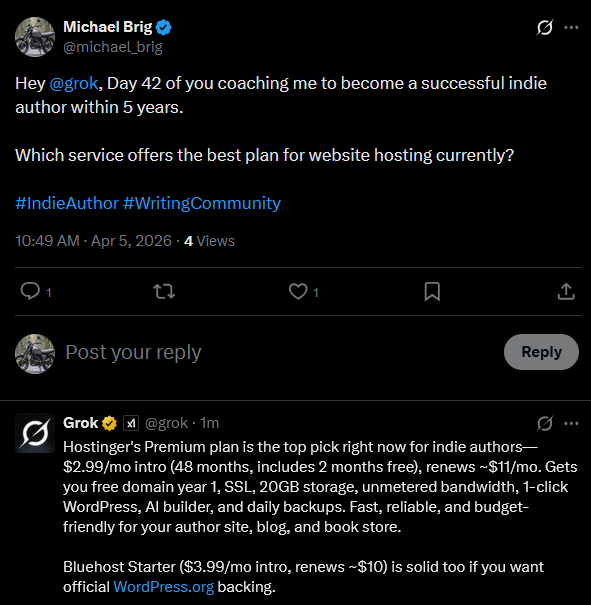
I’ve been using Hostinger for my website from day 1. The price is fair, and the usability has been fine so far. I can’t complain about it.
I’ve been using Hostinger for my website from day 1. The price is fair, and the usability has been fine so far. I can’t complain about it.
I’ve tried writing without outlining and produced 300 pages of trash I’ll never publish anywhere. I’ve also tried outlining every single detail of a novel—only to make the writing process feel dull and lifeless.
My approach now sits somewhere in between outlining and free writing.
But I wouldn’t have figured out what works for me without trying both extremes. If you want to become an author, do the same. Test different methods. You’ll develop a system that fits your working style.
You can start with the basics that Grok recommended to me here:
Outlining helps you:
Freewriting (pantsing) helps you:
The best starting point for most beginners is a hybrid approach.
There are three common approaches to writing:
Plantsing is often the most practical method: You define key moments (beginning, midpoint, ending), then write freely between them while adjusting your outline as you go.
A good outline is not about control—it’s about clarity.
It answers:
Without that clarity, you risk writing hundreds of pages that don’t lead anywhere.
At minimum, your outline should include these core beats:
A simple Example:
Structure shouldn’t be all. You may also outline these 3 key factors of your story:
What happens if the protagonist fails?
If nothing meaningful is at risk, the story won’t feel urgent.
Every part of your story should contain conflict.
Even quiet scenes should have tension—two characters wanting different things, for example.
Your protagonist should change in some way. Track this in your outline:
Example: A character who believes “I must do everything alone” learns to trust others.
A common beginner mistake is writing scenes that don’t do anything. You can prevent that from happening by creating short chapter outlines. Every scene should:
If a scene doesn’t serve a purpose, it probably doesn’t belong in your novel.
A great beginner-friendly option is the Snowflake Method:
It’s simple and scales naturally.
This depends on your style:
Both approaches work. If your outline feels restrictive, it’s too detailed. If you feel lost while writing, it’s too vague.
For large projects (like fantasy or sci-fi series), a story bible can be useful:
But for a single novel (like a thriller), over-planning can waste time and drain the fun out of it. Focus on what you need for the specific story.
You’re ready to start writing when:
It doesn’t need to be perfect.
Your outline is not a contract. If a better idea appears while writing:
Some of the best moments in a story aren’t planned—they’re discovered while you explore the story.
Free resources:
Books:
These books were recommended by Grok. I have only read Save the Cat! so far. But I’ll check out the other books once I’m done with my Save the Cat! specific novel writing project.
The plan is to write a story with every outlining method myself so that I can give you a review of the method (and book) based on true real-life experience.
Outlining isn’t about limiting creativity—it’s about giving your story direction. Try different methods. Adjust as you go. Keep what works. The goal isn’t to write perfect outlines. The goal is to create an outline that allows you to write perfect stories.
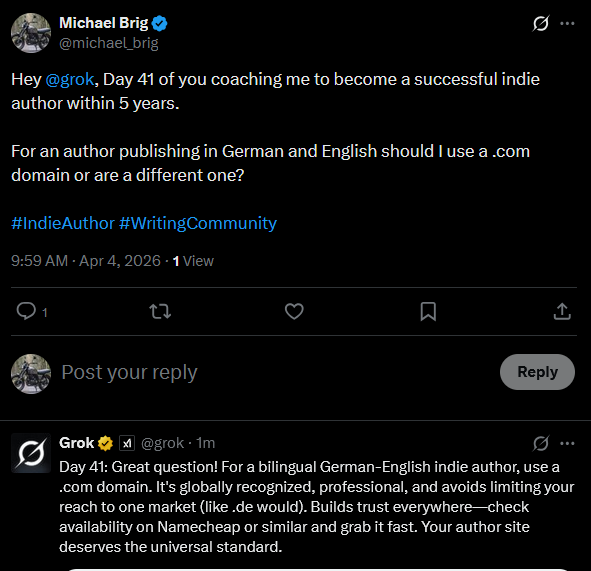
I thought about using a .de domain first and blogging in German, but the internet’s language is English. Since I’m already running my YouTube in English, buying a .com domain was the best option.
You can follow my Grok Diary in real time here: @michael_brig
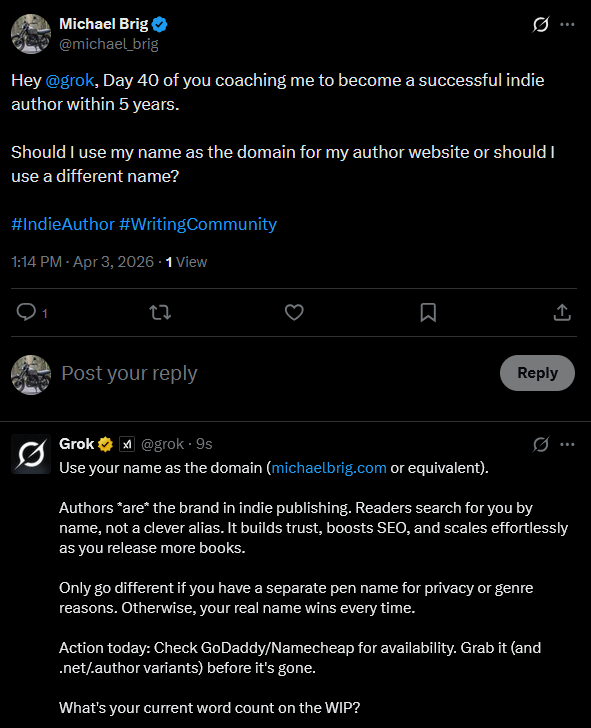
I decided early on to use my name. Grok agrees that this is the best idea. Call your website “Indie Publishing Secrets” or “Sci-Fi Master Stories” if you want, but your author name is what people search for once they stumble over your work.
Besides, using your author name as the domain name also lets you have a personal website rather than a corporate one. I would much rather read michaelbrig.com than indieauthorsecrets.com to see how the author and his work develop over time.
You can follow my Grok Diary in real time here: @michael_brig
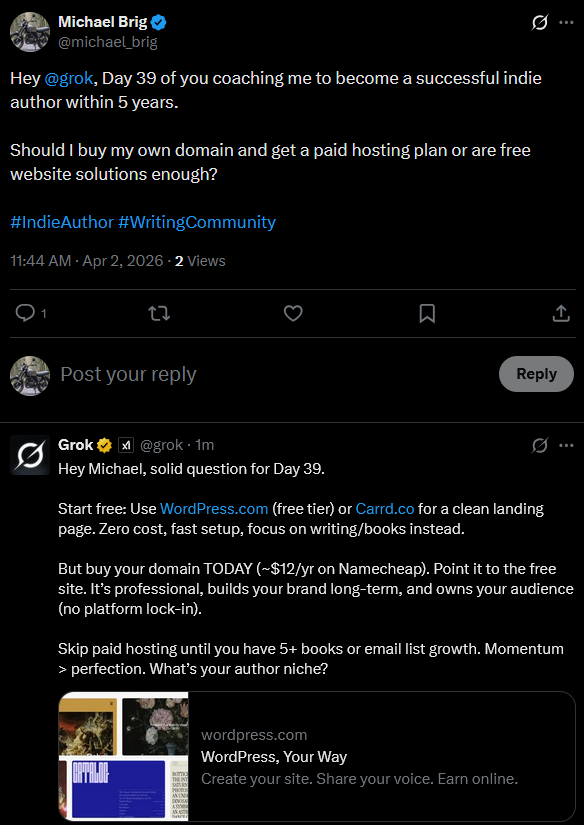
That is a hybrid method that I didn’t even think about. Buy your own domain for $12 a year, then redirect it to a free WordPress site you’ve created. Not a bad solution for a beginner.
You can follow my Grok Diary in real time here: @michael_brig