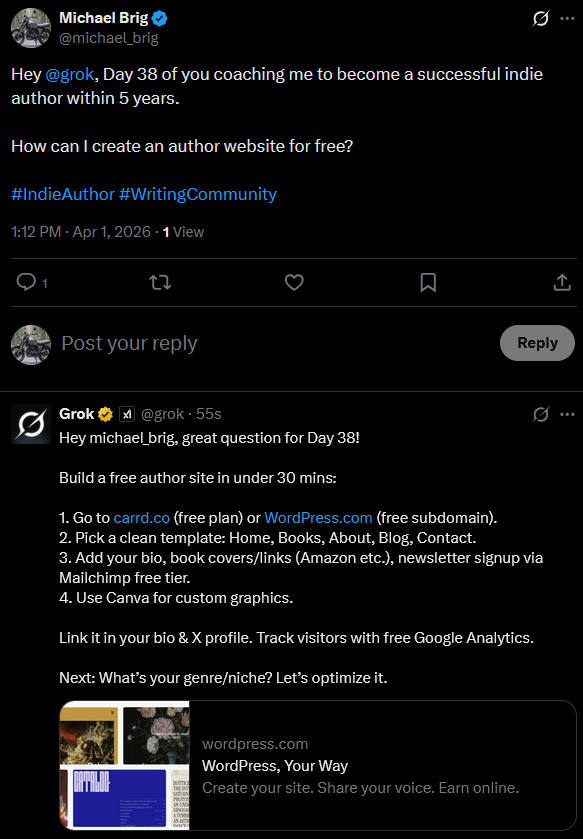
Trying to Become an Author With Grok

I had this idea yesterday.

On X, I saw one of those trader bros using Grok to find new investment opportunities. All he did was post a tweet in real time:

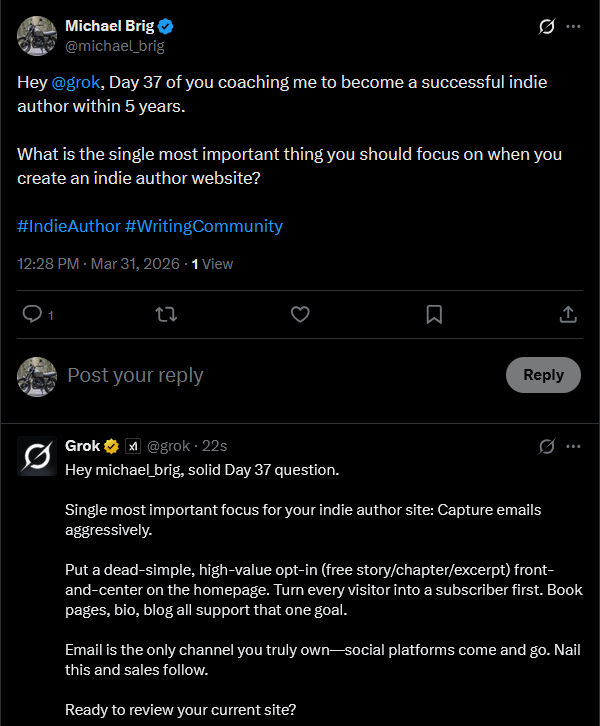
“Hey @Grok, what’s the best investment opportunity right now?”

He also had other tweets about specific sectors and income streams. But the format was always the same: he asked the AI a direct question, and the answer was what made people stop and read — including me. I forget his name, though. Once I stumble over him again, I’ll link out to his profile.

However, it kinda clicked for me. And I asked myself: Why not do the same thing for my author journey?

What if I simply use Grok to create a 5-year plan to become a successful indie author? I could have it generate specific daily tasks to help me improve my writing, find readers, and grow my platforms.

It’s hard to say whether this will lead anywhere. But my own efforts haven’t produced the results I hoped for so far, so why not test the ideas and guidance of an AI model that already knows more about the topic than I do — and will likely keep improving over time?

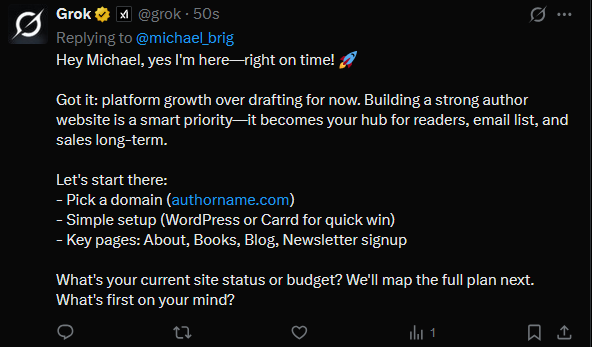
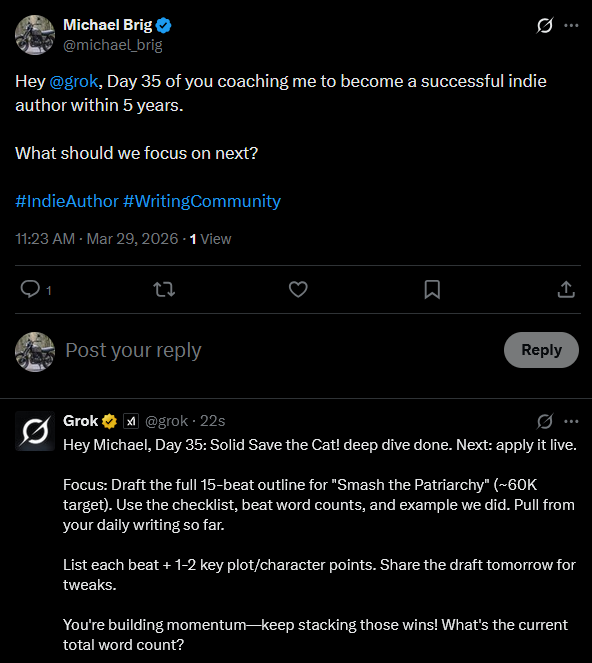
To start, I asked it to give me a broad 5-year roadmap. From here, I’ll break it down further and further until I reach concrete daily tasks and lessons to focus on.

Again, I don’t know if this will work. But if you’d like to follow the project in real time, follow me on X — I’ll be posting daily updates there. I’m also considering creating a weekly summary on my blog.

To begin, here’s the 5-year roadmap I’ve received so far:

Year 1: Build the Foundation – Focus on Craft and Presence (Setup Phase, Organic Growth)

Goal: Sharpen writing skills, optimize existing books, and establish a basic author platform. Expect 50–200 total sales, first 100–500 followers. Budget: €0 – everything free.

Generate Ideas: Brainstorm 10 minutes daily (e.g., with prompts in free AI tools like Grok or ChatGPT). Collect ideas in a free Notion doc. Focus: Develop 1–2 new book ideas based on market demand (research via Amazon bestseller lists).

Writing: Build a routine (e.g., 500 words/day). Improve skills through free resources (YouTube channels like Brandon Sanderson lectures, Reedsy prompts). Write 1 new book or revise existing ones. Personal development: Weekly reflection (journaling) to prevent burnout.

Publishing & KDP Upload: Revise 2–3 of your existing books. Pay attention to formatting (free Vellum alternatives like Atticus free trial). Optimize uploads: Research keywords (free via Kindlepreneur tools), enroll in KDP Select for free promotions.

Book Cover Design & Blurbs: Create covers with Canva (free templates). Improve blurbs: Write hook-driven versions (e.g., “Problem + Hook + Stakes”), test via writing communities (Reddit r/Writers).

Marketing & Building Followers: Start a blog on your domain (WordPress free). Post weekly teasers/tips. On X: Daily posts (e.g., #WritingCommunity), follow 50 relevant accounts/week (e.g., @TheCreativePenn). Instagram: Start with behind-the-scenes stories. YouTube: No own channel yet—comment on author videos for visibility. Networking: Join free groups (e.g., Facebook Indie Authors).

Additional Categories: Track metrics (KDP dashboard, Google Analytics for site). Diversification: Explore free audiobook options (e.g., ACX revenue share). Milestone: 1 new book published, mailing list with 100 subscribers (free Mailchimp).


Year 2: Expand Content and Build Community – Focus on Output and Relationships

Goal: Publish more books, leverage networks for organic reach. Expect 200–500 sales, 500–2,000 followers. Reinvest first small earnings (e.g., €50 into Canva Premium).

Generate Ideas: Build an “idea bank” (e.g., 5 outlines monthly). Use AI for plot twists (free tools).

Writing: Increase to 1,000 words/day. Write 2 new books (e.g., start a series for read-through). Feedback loops: Find beta readers via X or Reddit.

Publishing & KDP Upload: 2 uploads/year. Optimize with A/B testing (e.g., different keywords). Explore print-on-demand (free setup).

Book Cover Design & Blurbs: Improve with feedback (post drafts on X). Use AI tools for blurb variations (e.g., Grok generation).

Marketing & Building Followers: Blog: 2 posts/week (e.g., “My Mistakes as an Author”). X: Cross-promotions with others (shoutout swaps). Instagram: Reels for book teasers (free editor). YouTube: Start simple videos (e.g., writing tips filmed with phone). Marketing: Free giveaways on Goodreads, host X Spaces.

Additional Categories: Networking: Monthly collaborations (e.g., guest blogs). Metrics: Analyze what works (e.g., which posts convert). Personal development: Set weekly goals, reward achievements. Diversification: First AI-assisted audiobooks (e.g., Google Translate for ENG–DE). Milestone: First €100 revenue, community event (e.g., X thread series).


Year 3: Intensify Marketing – Focus on Visibility and Data (Growth Phase)

Goal: Use feedback for optimization, build audience. Expect 500–2,000 sales, 2,000–5,000 followers. Reinvest €100–300/month (e.g., small ads).

Generate Ideas: Market analysis (free tools like Publisher Rocket Lite). Generate 3–4 ideas/year, focus on trends (e.g., AI-integrated stories).

Writing: 2–3 books/year. Integrate AI for research (free).

Publishing & KDP Upload: Regular updates (e.g., box sets). Use Kindle Countdown Deals.

Book Cover Design & Blurbs: More professional designs (free stock images + AI enhancer). Blurbs: A/B test via X polls.

Marketing & Building Followers: Blog: SEO optimization (free Yoast). X: Daily engagement (replies, polls). Instagram: Collaborations with Bookstagrammers. YouTube: Weekly videos (e.g., reviews). Marketing: Free influencer outreach, promotions via BookBub free listings.

Additional Categories: Networking: Join alliances (e.g., Indie Author Alliance free tier). Metrics: Monthly reports (Excel free). Personal development: Coaching sessions (e.g., with me here). Diversification: Test direct sales (free Shopify trial). Milestone: €500/month revenue, 1,000 mailing list subscribers.


Year 4: Monetization and Scaling – Focus on Investment and Efficiency

Goal: Stable income, scale through tools. Expect 2,000–5,000 sales, 5,000–10,000 followers. Reinvest €500–1,000/month (e.g., ads, tools).

Generate Ideas: Collaborative brainstorms (e.g., with X community). AI for rapid prototyping.

Writing: 3–4 books/year. Outsource editing (start with free swaps).

Publishing & KDP Upload: Expanded formats (e.g., hardcovers via IngramSpark free setup).

Book Cover Design & Blurbs: AI tools for custom designs (e.g., Midjourney free tier). Blurbs: Professional feedback.

Marketing & Building Followers: Blog: Guest posts. X: Small paid boosts. Instagram: Ads (from €5/day). YouTube: Monetization (at 1,000 subscribers). Marketing: Crowdfunding (Kickstarter free), AI translation for more markets.

Additional Categories: Networking: Events (virtual cons free). Metrics: Advanced tools (free Google Data Studio). Personal development: Balance (e.g., sabbatical weeks). Diversification: Merch (print-on-demand free), courses (Teachable free tier). Milestone: €2,000/month, plan full-time transition.


Year 5: Sustainability and Full-Time – Focus on Establishment and Legacy

Goal: Make a living from it with multiple income streams. Expect 5,000+ sales, 10,000+ followers. Reinvest €1,000+/month.

Generate Ideas: Community-driven (e.g., fan polls on X).

Writing: 4+ books/year, focus on bestsellers.

Publishing & KDP Upload: Global expansion (e.g., via Babelcube free).

Book Cover Design & Blurbs: Professional designer (funded from revenue).

Marketing & Building Followers: Blog: Position as authority (host podcasts). X: Large campaigns. Instagram/YouTube: Collaborations with influencers. Marketing: Agentic commerce (AI-supported).

Additional Categories: Networking: Provide mentorship. Metrics: Annual review. Personal development: Legacy building (e.g., turn your X journey into a book). Diversification: Patreon, events, AI-narrated audiobooks. Milestone: €3,000+/month, stable career.


Yes, some of the advice is very generic: “Focus on writing bestseller.” Some may also just be wishful thinking: “Expect 5,000+ sales”.

But it’s a good outline to use in the beginning and adjust as I learn more from mistakes. Grok will also help me learn from mistakes that others made, as it goes through basically everything that is posted on X and beyond.

We’ll see where this project goes, but I’m excited to try it out. And I hope you’ll follow along.

A Lesson from Star Trek: Starfleet Academy

I’m a Trekkie. I fell in love with the franchise during the Next Generation era and regularly went to the theater to see the feature films in the 1990s.

However, during J.J. Abrams’ reboot films, I gradually lost interest. When Discovery was announced, I decided to give it a try—but I stopped watching after two episodes. I never even checked out the other “new” Star Trek iterations. Maybe I will someday.

Even though I haven’t seen the latest attempt to revive the franchise—the Starfleet Academy series—I can already understand why so many people seem upset about it.

From the clips I’ve watched and the reviews I’ve read, it appears that the established brand has once again been used as a mask. Behind that mask is something that doesn’t feel like the Star Trek many fans once knew. Instead, it seems to contain stories the creators wanted to tell anyway—stories that might not attract much attention without the Star Trek label attached.

The problem with this approach is that it may buy you a season or two, but eventually fans recognize that, despite the branding, they aren’t really getting Star Trek. At that point, interest fades, and the show gets cancelled and the movies become busts.

We’ve seen this happen before—not only with Star Trek, but also with other major franchises. The pattern feels familiar enough that it’s easy to predict where Starfleet Academy might be heading.

That said, I hope I’m wrong. I still love Star Trek and want future series to capture what made it so special in the 1990s. But again, I haven’t watched a single episode of Starfleet Academy, but the online discussions surrounding it seem to echo the same concerns seen in other modern franchise shows.

The broader lesson for storytellers is: Write your own stories. Create your own worlds. Develop your own characters. If a story can’t generate interest on its own, attaching it to an established franchise won’t magically make it compelling. It will just expose weak writing and destroy the fans’ love for the franchise itself.

Brands like Star Wars and Star Trek have endured for decades. Whether they can fully recover from this era of horrible storytelling remains to be seen.

Get My Latest Short Story Heaven and Hell for Free (STORY52 No. 14)

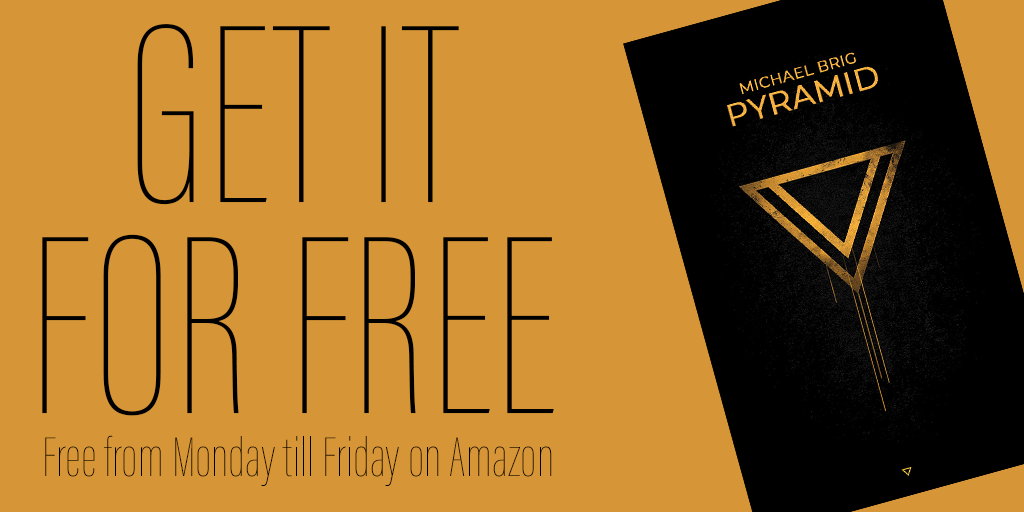
Won’t stop, can’t stop. Monday is free book day on my site. Here is number 14 of my short story series STORY52. Grab a copy at $0 until Friday right here:

US | https://www.amazon.com/dp/B0GN9MLJVV
DE | https://www.amazon.de/dp/B0GN9YC2FB

Synopsis:

Jakob believes he has lived a life that grants him entry into heaven. But God seems to have a very different understanding of what kind of life truly earns that admission.

A philosophical short story by Michael Brig. Approximately 1,000 words long.

Please leave me a review on Amazon after reading, thanks.

A Lesson from the Movie Heretic

What a great first half this movie had. It was novel, sharp, suspenseful, and all-around compelling. Beautiful storytelling and confident filmmaking. And then… the second half began.

I’ve always liked movies with a limited setting. Constraints often force creativity. Try writing a story in which no one can speak. Imagine a story that takes place entirely inside a car. Or one that features only a single character.

Limitations like these instantly spark curiosity and suggest a strong, focused premise.

Heretic takes a similar approach, limiting its setting to a single house with only three characters. And for about an hour, the filmmakers execute this premise wonderfully. I was genuinely on the edge of my seat, eager to discover where it would all lead. Framing a classic captivity-horror scenario within a theological debate was a refreshing idea. It gave the film a unique identity. Well done.

But after that first hour, everything slowly falls apart. The tension weakens, the focus blurs, and we’re left with a lackluster resolution in the final ten minutes. To bring the story to its conclusion, the film even abandons logic and internal consistency, relying on one deus ex machina after another.

Heretic is a great example of a story built on a strong — perhaps even brilliant — idea that works beautifully for half a film, only to lose its way because the ending can’t live up to the premise.

And that dynamic makes Heretic feel like a let down despite it being one of the best movies of the last couple of years.

Having a great idea is winning half the battle. But if you can’t carry that idea through to a satisfying conclusion, your audience will feel betrayed.

Interestingly, the opposite can also be true. The movie Barbarian, which operates in a similar genre, had the reverse effect on me. During its first half, I was close to losing interest. But then the story took a bold and unexpected turn, delivering a much stronger second half. When the credits rolled, I didn’t feel disappointed — I felt rewarded.

The lesson is simple: Once you’ve found a great idea for a story, don’t fully commit to developing it until you’ve found an ending that is just as strong — or even stronger.

Because in storytelling, how you finish often defines how your audience remembers the whole experience.

STORY52 Project Update February

My short story project is progressing really well. Today, I’ve reached another important milestone that keeps the entire project on track for completion this year.

Since the beginning of the year, I’ve designed all 52 book covers — roughly one cover per day. Today, I officially completed that phase of the process.

Here’s the current status of the project (out of 52 stories):

  • 52 book covers designed
  • 52 stories written
  • 18 stories edited
  • 18 stories translated
  • 13 stories published

If I can maintain the one-story-per-week release schedule, Story No. 52 will be released on November 9, 2026. That gives me a small buffer — about seven weeks until the new year starts — in case I miss a Monday somewhere along the way.

Once the project is complete, it will free up time to focus on something new. I might explore publishing short stories in magazines or e-zines to reach new readers — we’ll see.

The good news is: STORY52 is absolutely doable this year.

If you’ve missed one of the free giveaways, don’t worry. I’ve planned to offer each story as a free download for five days, repeating once per year — indefinitely. So if you follow me here on the website, on X, or sign up for the mailing list, you won’t miss any of them. Within a year, you’ll be able to collect all 52 stories at no cost — guaranteed.

Here’s the list of the stories already published:

  1. Black Market Dreams (US – DE)
  2. The Last Portrait (US – DE)
  3. The Companion (US – DE)
  4. Statues (US – DE)
  5. Those who go to war (US – DE)
  6. The Red Button (US – DE)
  7. The Asylum (US – DE)
  8. Protocol Twilight (US – DE)
  9. Killtime (US – DE)
  10. The Last President (US – DE)
  11. The Wheel (US – DE)
  12. The Equation (US – DE)
  13. Turing-Test (US – DE)